






















Blueprint for “New Gaza” Unveiled Amid Controversy
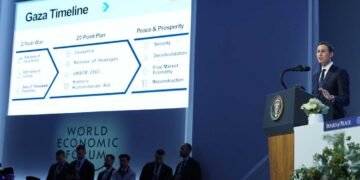
DUBAI, United Arab Emirates — The Trump administration’s ambitious plan for a reconstructed Gaza, termed “New Gaza,” was recently introduced by Jared Kushner at the World Economic Forum in Davos, Switzerland. This development follows years of devastating conflict and aims to transform the war-torn territory into a symbol of hope and prosperity, yet raises significant questions about feasibility and local input.
Why It Matters
The proposal comes in the wake of extensive destruction in Gaza, where a humanitarian crisis looms large. With critical infrastructure damages estimated at over $18 billion, the plan’s implications transcend mere urban development, touching on broader geopolitical dynamics and the lives of millions of Palestinians who remain displaced and vulnerable.
Key Developments
- Kushner’s plan includes luxury apartments, industrial zones, and parks, emphasizing hope for economic growth.
- The framework stipulates that reconstruction will only occur in areas where Hamas has disarmed, raising concerns over the exclusion of large populations.
- Critics argue that the plan disregards the realities for current residents and lacks clear provisions for housing allocation.
- A new airport and logistics hub are proposed, but control over border crossings remains a contentious issue.
- Notable criticism highlights that areas considered for redevelopment erase existing communities, prompting calls for local involvement.
Full Report
A Vision for the Future
During the forum, Kushner outlined the potential for “New Gaza,” featuring modern loft-style apartments, expansive parks, and high-tech industrial zones. He asserted that initial recovery efforts, including debris removal, have already commenced. The proposal hopes to generate significant employment opportunities for the Palestinian population within a reimagined landscape.
Reconstruction Conditions and Challenges
The reconstruction effort hinges on a ceasefire agreement linked to the disarmament of Hamas, complicating matters as this will restrict development to areas fully controlled by Israeli forces. Critics in Gaza have voiced skepticism regarding this condition and its implications for their communities. Many residents fear displacement and question the absence of legal frameworks for land transference and housing allocation.
The Urban Landscape Reimagined
The plan presents a radical redesign of Gaza, grouping residential zones into separated, quadrantal sections with minimal connectivity. The vision eliminates certain northern cities and refugee camps, replacing them with agricultural areas and data centers. There is little clarity on what this will mean for those currently residing in these spaces.
Beyond Infrastructure: Economic Aspirations
Kushner’s proposal entails a new airport and logistics hub in southern Gaza, aimed at fostering economic growth through enhanced connectivity. As it stands, access to Gaza is tightly controlled, with residents largely dependent on limited crossings sanctioned by Israel. The plan’s reconfiguration seeks to shift this dynamic but raises questions about economic sovereignty and independence for Palestinians.
Rafah’s New Role
The city of Rafah is positioned to become a central hub in this reimagined Gaza, with over 100,000 promised housing units and numerous educational institutions. However, this area, currently under military occupation, faces challenges in accommodating displaced populations from northern Gaza.
A Coastal Tourist Destination
The plan envisions transforming Gaza’s coastline into a bustling tourist attraction, featuring modern towers and mixed-use developments. This ambitious vision risks alienating current residents, who may be priced out of the newly established real estate market, fundamentally altering the socio-economic fabric of the region.
Context & Previous Events
The Gaza Strip previously housed about 2.2 million residents, primarily in urban areas and refugee camps. The region has faced significant violence and destruction due to ongoing conflicts, leaving many citizens in dire living conditions. The plan introduced by Kushner hinges on the broader geopolitical context, notably the ongoing struggle between Hamas and Israel.






