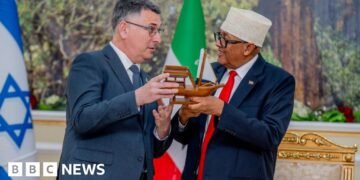























Israel’s Foreign Minister Gideon Saar has made his inaugural visit to Somaliland, marking a significant step following Israel’s recent and controversial recognition of the region as an independent nation. The visit comes in the wake of Israel becoming the first country to officially recognize Somaliland, a territory that declared independence from Somalia over 30 years ago.
This development is significant as it not only highlights Israel’s efforts to forge new alliances in a strategically important region but also raises tensions with Somalia, which continues to assert that Somaliland is integral to its territory. The international response to Israel’s recognition has been marked by both condemnation and endorsement, reflecting the complexities of geopolitical dynamics in the Horn of Africa.
Key Developments
- Gideon Saar emphasized Israel’s commitment to enhancing relations with Somaliland during his meetings with President Abdirahman Mohamed Abdullahi.
- Saar’s visit is seen as a celebration of Somaliland’s recent recognition by Israel, which was met with condemnation from Somalia.
- Abdullahi characterized the visit as a “big day” and stated that Somaliland would cooperate with Israel in strategic interests.
- Somalia condemned the recognition, calling Saar’s visit “unacceptable interference” in its internal affairs.
- Israel’s recognition has prompted reactions from various nations and organizations, culminating in an emergency UNSC meeting.
- Abdullahi has expressed interest in joining the Abraham Accords, a series of normalization deals between Israel and several Arab states.
- Despite hopes for international recognition, India’s foreign ministry dismissed claims that they would follow suit.
Full Report
Visit and Dialogue
During his meeting with President Abdullahi, Gideon Saar stated that Israel aims to advance relations with Somaliland “with momentum.” Following their discussions, Saar took to social media to depict the breadth of the talks, indicating a focus on a comprehensive relationship between Israel and Somaliland. Abdullahi praised Israel’s recognition as a “courageous decision,” suggesting that Somaliland would work closely with Israel in the future.
International Reaction
Somalia reacted swiftly to the recognition and Saar’s visit, labeling the actions as inappropriate interference. The backlash included international criticism from countries such as China and Turkey, as well as statements from the African Union and the European Union urging respect for Somalia’s sovereignty. Conversely, the U.S. defended Israel’s position, accusing critics of applying double standards regarding sovereignty and recognition.
Future Implications
Israeli analysts propose that the recognition arises from strategic interests in the Red Sea region, particularly regarding potential military engagements with groups such as the Iran-backed Houthis in Yemen. As part of this collaboration, Israel has indicated intentions to cooperate with Somaliland in various sectors, including agriculture, technology, and health.
Potential for Broader Recognition
Somaliland’s aspirations for wider international recognition may also be gaining traction among other nations following Israel’s endorsement. However, this optimism was tempered by India’s foreign ministry, which refuted social media assertions about plans to recognize Somaliland, labeling the claims as “fake.”
Context & Previous Events
Somaliland declared its independence from Somalia in 1991, following the ousting of the country’s military dictator Siad Barre. Despite its self-proclaimed status, the region’s independence has not garnered widespread international recognition until Israel’s announcement last month, which surprised many observers and ignited global discussions regarding territorial sovereignty.