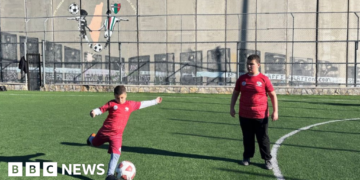
























A Palestinian children’s football club in the occupied West Bank is on the brink of demolition despite a robust international campaign advocating for its preservation. The club, hailed as a crucial outlet for local youth, is caught in a contentious dispute over alleged lack of construction permits, highlighting broader tensions in a region deeply marked by conflict.
This situation underscores the fragility of hope and opportunity for young Palestinians in an area plagued by political strife. The football pitch has become a symbol of resilience against the backdrop of the Israeli-Palestinian conflict, where even small spaces for play are disputed.
Key Developments
- The football club, located near Bethlehem, received a demolition order from Israeli authorities for allegedly being built without necessary permits.
- After a lawyer’s intervention, the club was granted a seven-day reprieve, which has since expired.
- The Aida Youth Centre serves over 200 children, many of whom come from the nearby Aida refugee camp, which is a historically significant area.
- Supporters, including notable figures and international organizations, have launched petitions and social media campaigns in defense of the club.
- The Israeli military contends the construction violates regulations in an area where they assert full civil control.
Full Report
Imminent Demolition
The club’s predicament has garnered significant media attention as it plays a vital role in the lives of local children, providing a rare athletic outlet in a challenging environment. Young players such as 10-year-old Naya articulated their connection to the field, explaining that it embodies their dreams and aspirations. “If they demolish our field, they will demolish our dreams,” she said while donning a Brazilian jersey featuring Neymar’s name.
Community Resilience
The community has actively opposed the demolition order through online advocacy, gathering wide-ranging international support. While the local football pitch symbolizes hope for these children, its future hangs in the balance amid ongoing tensions in the region.
Israeli Authority’s Stance
Israeli officials assert that the football field was constructed unlawfully on land classified as Area C, over which Israel maintains exclusive control. A spokesperson from the Israel Defense Forces emphasized that the construction violates established prohibitions. Critics argue, however, that the denial of permission for such projects alongside expanding Israeli settlements in the same areas demonstrates a systematic approach to suppress Palestinian aspirations.
Local Perspectives
Members of the Aida Youth Centre express a belief that the threat of demolition transcends mere legalities. Board member Mohammad Abu Srour articulated a sentiment that the demolition is part of a broader strategy to undermine Palestinian hope and opportunity, asserting, “The moment that we lose hope… we are going to leave.”
Context & Previous Events
The terrain surrounding Bethlehem is complex, with administrative divisions established during the Oslo Accords in the 1990s. Areas A and B are managed by the Palestinian Authority, while Area C remains under Israeli control. The West Bank’s governance structure remains a point of contention as both sides have yet to resolve longstanding grievances, complicating any progress toward peace.
Since the onset of the Israeli occupation, construction permits have been a significant source of contention, with critics noting that while Palestinian structures are often ordered for demolition, Israeli settlements have seen expeditious approval for expansion.