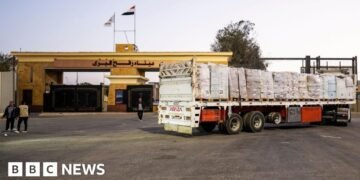























Israel Agrees to Conditional Reopening of Rafah Crossing Amid Hostage Search
Israel has conditionally agreed to reopen the Rafah crossing between Gaza and Egypt, a vital border point, following an operation to retrieve the remains of the last Israeli hostage held in Gaza. The move comes as part of ongoing negotiations regarding humanitarian access and political resolutions involving the region.
Why It Matters
The Rafah crossing’s status is critical for humanitarian efforts, especially in light of the ongoing conflict and humanitarian crisis in Gaza. Its reopening could provide essential aid to Palestinians while also representing progress in negotiations between Israel and Hamas, amid broader international efforts for a peaceful resolution.
Key Developments
- The Rafah crossing, largely closed since May 2024, is set to reopen conditionally after Israel’s military concludes its operation to locate the remains of Master Sgt Ran Gvili.
- Israel’s military has initiated a focused search in northern Gaza, specifically targeting areas believed to contain Gvili’s remains.
- The Israeli government plans a “full monitoring mechanism” at the Rafah crossing, including oversight of entry and exit lists.
- Hamas’ military wing has stated it provided information about the location of Gvili’s body to mediators.
- The Israeli Prime Minister’s office confirmed a limited reopening for pedestrian passage, following U.S. negotiations.
Full Report
Conditional Reopening Announced
Israel’s conditional agreement to reopen the Rafah crossing hinges on a successful operation to recover the remains of Ran Gvili, the last Israeli hostage taken during the conflict. The crossing has been predominantly closed since May 2024, when it was seized by Israeli forces. The Israeli government initially signaled that it would reopen during the first stage of a ceasefire with Hamas, which began in October, but complications have delayed this process.
Search Operation Underway
On Sunday, Israel’s military confirmed it began a new search for Gvili’s remains in northern Gaza. Specific operations are reportedly occurring at a cemetery in Gaza City and may take several days, according to Israeli military officials. The search involves specialized teams, including rabbis, dental experts, and search teams equipped with mobile X-ray machines.
Monitoring Protocols Established
In its plans for the Rafah crossing, Israel announced the establishment of a comprehensive monitoring protocol, which will include oversight of who enters and exits the territory. A new screening area is to be created around the Yellow Line, which marks territory controlled by Israeli forces as per the ceasefire agreement. The crossing’s limited reopening, though aimed at allowing pedestrian passage, remains contingent on security inspections.
Family and Political Reactions
Gvili’s family has made clear their opposition to the reopening of the Rafah crossing until his remains are returned for burial in Israel. They emphasized that bringing Ran home is their foremost priority. Concurrently, efforts by U.S. mediators continue to engage both parties in discussions aimed at advancing a peace plan proposed by former President Trump.
Context & Previous Events
The situation escalated following a Hamas-led attack on October 7, 2023, resulting in significant casualties. Approximately 1,200 individuals were killed, and many were taken as hostages, prompting a substantial Israeli military response in Gaza that has resulted in significant loss of life. The Israeli government had projected a forthcoming opening of the Rafah crossing in early December to facilitate Palestinian movement, but disputes with Egypt over terms have complicated these plans.