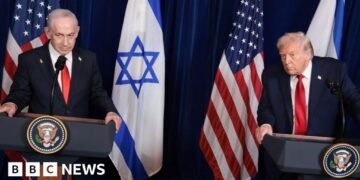























Israeli Prime Minister Benjamin Netanyahu has called an urgent meeting with his top advisers to discuss U.S. President Donald Trump’s newly announced “Board of Peace” aimed at addressing the humanitarian situation in Gaza. This comes after Israel expressed concerns about not being included in discussions regarding the board’s composition, particularly in light of significant figures named to the Gaza Executive Board, including former UK Prime Minister Tony Blair and Jared Kushner, Trump’s son-in-law.
The developments come at a critical moment as the humanitarian crisis in Gaza intensifies, raising urgent questions about governance and reconstruction in the region.
Key Developments
- Trump’s “Board of Peace” for Gaza has been announced amid ongoing conflict and humanitarian issues.
- Israel’s Netanyahu and his administration have criticized the plan, stating it contradicts their policies.
- The Gaza Executive Board consists of various international figures, none of whom are Palestinian.
- Israel’s opposition leader termed the initiative a diplomatic failure, while the presence of critical nations, such as Turkey and Qatar, raised eyebrows.
- The United Nations has warned that the humanitarian crisis in Gaza is far from resolved.
Full Report
Ongoing Tensions Over Leadership in Gaza
Israeli officials have expressed frustration over the inaugural members of the Gaza Executive Board, which include prominent international figures but lack Palestinian representation. Netanyahu’s office firmly stated that the announcement was not coordinated with Israel and runs counter to its established policies concerning Gaza administration.
The board is tasked with overseeing both the immediate governance of the region and the long-term reconstruction efforts following significant destruction during the conflict. Currently, the only Israeli member, businessman Yakir Gabay, is based in Cyprus, while all members from Turkey and Qatar have been critical of Israeli policies in Gaza.
Response to Trump’s Initiative
Netanyahu’s administration is unlikely to support a board that they believe undermines Israel’s interests, especially during such a sensitive period. In a statement on social media platform X, Israel’s National Security Minister Itamar Ben-Gvir asserted that Gaza requires military action to eliminate Hamas rather than governance by an administrative committee. Conversely, opposition leader Yair Lapid labeled the initiative a significant diplomatic misstep for Israel.
International Participation and Financial Commitments
The structure of the Board of Peace remains somewhat ambiguous, with Trump positioned as its chairman. While several world leaders from countries including the UK, Hungary, and various others have reportedly been invited to participate, reactions have been mixed. Hungarian Prime Minister Viktor Orban has confirmed acceptance, while other leaders await further clarification on the role and responsibilities of the board.
Reports indicate Trump is asking nations to contribute financially, with estimates around $1 billion for membership, although countries can opt for a three-year membership without a financial commitment. This point has raised questions and concerns, particularly from Canada, where officials noted budget constraints.
Humanitarian Crisis Worsening
The international community remains on alert regarding the humanitarian situation in Gaza, with the United Nations estimating that approximately 80% of its buildings have either been damaged or destroyed. Families that survived the military action are now facing the harsh realities of winter, compounded by shortages of food and shelter. UN representatives have criticized the limited aid efforts, describing them as inadequate responses rather than long-term solutions.
Israel’s government asserts that it is facilitating humanitarian assistance but has pointed fingers at the UN for inefficiencies in delivering aid. They defend their restrictions as necessary measures to prevent Hamas from exploiting aid resources.
Context & Previous Events
President Trump’s “Board of Peace” is part of a broader 20-point plan aimed at ending the ongoing conflict between Israel and Hamas. The inclusion of various international figures like former UK Prime Minister Tony Blair and Jared Kushner illustrates the administration’s inclination towards establishing a multilateral approach to governance in Gaza. Nonetheless, the lack of Palestinian representation on leadership boards and rising tensions with Israeli officials indicate the complexities of the situation and the challenges to achieving peace in the region.