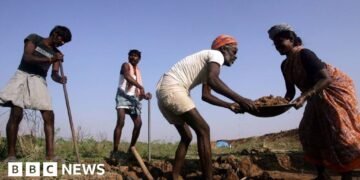























India’s Rural Employment Scheme Faces Major Reform Amid Criticism
India’s National Rural Employment Guarantee Scheme (NREGS), an ambitious program providing rural households with the right to paid work, has undergone significant reforms. While the initiative increases the annual guaranteed workdays from 100 to 125, concerns have been raised about funding shifts that may undermine its effectiveness.
Why It Matters
The NREGS has been crucial for rural livelihoods in India, particularly for the millions who rely on agriculture and unskilled labor. With approximately 65% of Indians living in rural areas, any changes to this framework could have wide-reaching implications for poverty alleviation and economic stability in the country. Critics caution that the new funding structure may dilute the welfare benefits that many families depend on.
Key Developments
- The Indian government has introduced a new law, G RAM G, which rebrands and modifies the existing NREGS.
- The annual employment guarantee for rural households has increased from 100 to 125 days.
- States are now responsible for a larger share of the costs, shifting from a previously established 90:10 federal-state funding model to a 60:40 split.
- The federal government retains control over the scheme’s operation, including fund allocation.
- Critics argue that the reforms will weaken the legal rights afforded by the original program.
Full Report
Legislative Changes
The G RAM G law, unveiled last week, repeals and rebrands the longstanding NREGS. The government aims to modernize the program, promising to deliver a more efficient and less corrupt system that effectively supports the poor. Federal Agriculture Minister Shivraj Singh Chouhan touted the reform as a significant advancement for employment security.
Funding Concerns
Historically, the federal government covered nearly all labor and material costs under the NREGS. However, the new funding model requires states to contribute up to 40% of total costs. This funding shift raises concerns that it may limit states’ ability to effectively implement the program, especially in resource-strapped regions. Critics assert that such changes could transform the employment guarantee from a legal right into a discretionary scheme.
Program Utilization
Despite the increase in guaranteed workdays, experts like development economist Jean Dreze warn that the changes may be more cosmetic than substantive. A report by LibTech India revealed that only 7% of rural households were able to access the full 100 days of work during the previous financial year, raising questions about the effectiveness of raising the cap.
Impacts and Outcomes
Numerous studies indicate that the NREGS has positively impacted rural economies by increasing household earnings and lowering poverty rates. Research shows that beneficiary households experienced a 14% boost in earnings and a 26% reduction in poverty. However, ongoing issues such as underfunding and delayed payments continue to challenge the program’s effectiveness.
Context & Previous Events
Launched in 2005, the NREGS was instituted by the Congress party to address rural employment and poverty. It remains one of the world’s most studied anti-poverty initiatives, with a substantial focus on promoting equity, as over half of its 126 million workers are women. The program gained renewed significance during the COVID-19 pandemic, as large numbers of urban migrants returned to their villages, amplifying the demand for employment.
The recent changes to this foundational scheme underscore the complexities of rural livelihoods in India, where the struggle for economic stability continues. With the revamped version facing scrutiny, the future of one of the world’s largest employment guarantees remains uncertain.