






















Violence Erupts in Iran Amid Ongoing Protests and Economic Crisis
Recent unrest in Iran has ignited fears of government brutality as officials respond to widespread protests. The situation underscores an ongoing struggle within the country and demonstrates the pressure facing the Islamic regime due to external sanctions and internal dissent.
Why It Matters
The current wave of protests represents a significant test for Iran’s ruling government, which is grappling with economic hardship exacerbated by international sanctions. Understanding the regime’s response and internal dynamics is crucial for grasping the potential implications for regional stability and international relations.
Key Developments
- Ongoing protests have flared up in response to economic hardships and government repression.
- The Iranian Revolutionary Guards Corps is at the forefront of suppressing dissent, employing lethal force against protesters.
- UN sanctions reimposed by European nations have heightened the economic crisis, affecting food costs and weakening the national currency.
- U.S. threats of further sanctions, including tariffs on countries doing business with Iran, add to the regime’s challenges.
Full Report
Government Response to Protests
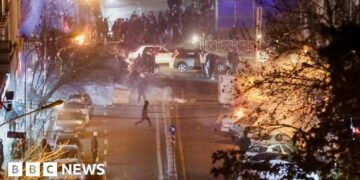
The Iranian government has faced significant public unrest in recent weeks, with demonstrators taking to the streets over rising living costs and government policies. In response, authorities have deployed security forces, including the Iranian Revolutionary Guards Corps (IRGC), to enforce stability by any means necessary. Eyewitness accounts reveal that these forces have resorted to violence against citizens, effectively quelling demonstrations for now.
Economic Hardships and Sanctions
Over the past two years, Iranian citizens have experienced severe economic strain, largely due to sanctions imposed by the United States and its allies. The reimposition of UN sanctions in September further exacerbated food inflation and drove the national currency, the rial, to an all-time low. As food price inflation exceeded 70%, many Iranians struggle to feed their families, leading to heightened public anger.
Political Dynamics and International Pressure
The Iranian leadership appears increasingly under pressure, as both domestic unrest and international threats loom large. Supreme Leader Ayatollah Ali Khamenei, whose main focus is to preserve the regime, is faced with questions about how to navigate talks with the U.S. while managing escalating protests at home.
Protests and Leadership Issues
While the protests have mobilized significant discontent, a lack of coherent leadership among the opposition hinders momentum. Attempts to unify resistance under figures such as the Shah’s exiled son have not yet gained substantial traction. As protests continue, the potential for further violent crackdowns remains imminent.
Context & Previous Events
Historically, Iran has seen outbreaks of public discontent, most notably during the widespread protests following the disputed presidential election in 2009. Previous reactions from the IRGC and the Basij militia were similarly characterized by violence against demonstrators. Observers have noted examples from other nations, such as Syria and Tunisia, where internal dissension led to abrupt regime changes, drawing parallels with the current situation in Iran.