






















Fatal Shooting of Minneapolis Woman by ICE Agent Sparks Nationwide Protest and Investigation
The fatal shooting of 37-year-old Renee Good by a U.S. Immigration and Customs Enforcement (ICE) agent in Minneapolis has ignited widespread protests and raised significant questions about the use of deadly force by federal agents. Video footage capturing the incident offers differing perspectives from local and federal officials, complicating the ongoing investigation.
Why It Matters
This incident has thrust national attention on the contentious issues surrounding law enforcement practices, particularly in the context of immigration enforcement. The contrasting narratives from government officials highlight the tensions between local jurisdiction and federal authority, as well as the larger national conversation regarding police responses to perceived threats.
Key Developments
-
Video Footage: Multiple videos emerged showing ICE agent Jonathan Ross shooting Good while she was in her vehicle. These videos are pivotal to the investigation, as they depict different actions and interpretations.
-
Divergent Accounts: President Trump referred to Good as a "domestic terrorist," asserting she attempted to run over the agent, while state officials maintain she was trying to leave the scene safely.
-
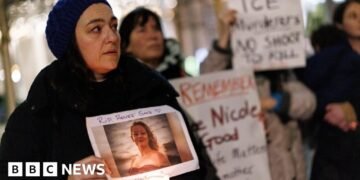
Protests Erupt: The shooting has triggered protests across the country, with demonstrators calling for accountability and justice in the wake of the incident.
- Investigative Challenges: Former law enforcement officials suggest that the strong public support for the agent from Trump and his administration could hinder an impartial investigation.
Full Report
Incident Overview
The shooting occurred as ICE agents were attempting to apprehend Good in a residential area. Footage shows agents instructing her to exit her vehicle. As the car begins to move, Agent Ross, while filming, raises his weapon and fires at Good. Local officials argue that this situation demonstrates Good was not a threat, as she was turning away from Ross when fired upon.
Justification of Deadly Force
Investigators will examine whether Ross’s actions comply with the Department of Homeland Security’s (DHS) policies regarding the use of deadly force. These policies permit agents to use lethal force if they perceive an imminent threat to themselves or others. The nuances of what constituted a threat at the moment will be crucial, particularly as Good’s vehicle was reportedly moving away from the officer when shots were fired.
Expert Opinions
Former FBI agents have provided insights into how investigators might frame the situation. While they note that Ross could argue he felt threatened based on a prior incident in which he was injured, concerns arise about the justification of multiple shots fired after Good’s vehicle began to pull away. “Just because you can take the shot doesn’t mean you should,” stated Robert D’Amico, a former FBI agent.
Political Dynamics
The political backdrop has complicated the investigation, as senior officials have publicly endorsed Ross’s actions. Minnesota Governor Tim Walz expressed apprehension that the federal review may be biased, emphasizing the need for a thorough investigation free from political interference. Additionally, Minnesota has initiated legal action against the federal government concerning ICE’s operations in the state.
Context & Previous Events
The ICE officer involved had sustained injuries from a previous confrontation with a driver, likely influencing his perception of threat during this encounter with Good. The incident, which falls under federal jurisdiction, highlights the evolving dynamics between federal immigration enforcement and community safety, raising ongoing questions about accountability in law enforcement practices.