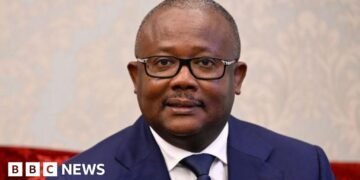























Guinea-Bissau’s ousted President Umaro Sissoco Embaló has safely arrived in Senegal following a military coup that overthrew his government this week. The West African country is now under the control of military leaders, as tensions escalate in the region amid allegations of electoral manipulation.
Why It Matters
The recent coup in Guinea-Bissau highlights the country’s ongoing political instability and its historical challenges with military interventions. With both internal and external pressures mounting, the situation raises concerns about regional democracy and governance, while exacerbating fears of violence and unrest.
Key Developments
- Embaló was flown to Senegal on a chartered military flight after negotiations by Ecowas.
- The military has appointed Gen Horta N’Tam as transitional leader for one year.
- The coup occurred just before the announcement of election results, suspending the electoral process.
- The military cited a conspiracy led by politicians and a drug baron aiming to destabilize the country.
- Protests have been banned, and a nighttime curfew has been enacted to maintain order.
- Both Embaló and his main opponent, Fernando Dias, claimed victory in the recent elections.
Full Report
Umaro Sissoco Embaló landed in Senegal late Thursday after being released from detention by military forces that staged a coup on Wednesday. Senegal’s foreign ministry confirmed his safe arrival following negotiations orchestrated by the Economic Community of West African States (Ecowas).
Shortly after the coup, the military swore in Gen Horta N’Tam as the new leader, marking yet another chapter in Guinea-Bissau’s tumultuous political history. Gen N’Tam’s government is intended to last for one year while officials navigate ongoing unrest. The military has justified its actions as a necessary step to protect democracy against a supposed plot involving prominent politicians and a well-known drug trafficker.
President Embaló had recently faced electoral challenges, with both he and his main competitor, Fernando Dias, proclaiming victory in the presidential elections held just days before the coup. The military has since halted the electoral process, blocked the release of results, and implemented measures to limit public gatherings.
Additional reports suggested that key figures, including Dias, former Prime Minister Domingos Pereira, and Interior Minister Botché Candé, have been detained by the military. As a response to the escalating situation, soldiers are patrolling the capital, Bissau, where most businesses were closed and tensions were palpable on Thursday.
In his speech after being sworn in, Gen N’Tam stated the military acted decisively to safeguard the nation’s democracy. Following the takeover, military authorities reopened borders that had been closed amidst the coup.
Context & Previous Events
The coup comes against a backdrop of Guinea-Bissau’s historical instability, marked by at least nine coups or attempted coups over the last fifty years since its independence from Portugal in 1974. The nation has been globally recognized as a drug-trafficking hub, complicating its political landscape and contributing to military influence over governance. The situation has drawn condemnation from various international bodies, including the African Union and the United Nations, both of which have called for a restoration of constitutional order.