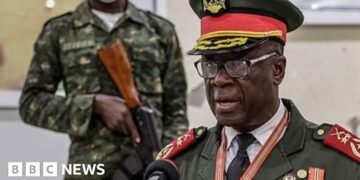























Guinea-Bissau Faces Political Turmoil as Army General Sworn In as Transitional Leader
An army general has been installed as Guinea-Bissau’s new head of state following an apparent coup that has unsettled the nation. General Horta N’Tam was sworn in on Thursday, marking the beginning of a one-year transitional presidency amid accusations of a staged coup by outgoing President Umaro Sissoco Embaló.
Why It Matters
This political upheaval raises questions about the integrity of the electoral process in Guinea-Bissau, a country plagued by instability and drug trafficking. The military’s intervention and suspension of election results could further jeopardize democratic governance in a region known for its susceptibility to military coups.
Key Developments
- General Horta N’Tam, previously the head of the presidential guard, was sworn in as the new transitional president.
- Civil society groups have accused President Embaló of orchestrating a “simulated coup” to manipulate electoral outcomes.
- The military has suspended the ongoing electoral process and detained several political figures, including Embaló’s main challenger, Fernando Dias.
- Gunfire erupted in the capital, Bissau, but it remains unclear who was involved or if there were any casualties.
- The African Union has called for the immediate release of detained officials and emphasized the need to uphold electoral processes.
- Portugal has urged a return to constitutional order and cautioned against any acts of violence.
Full Report
Transition to Military Leadership
General Horta N’Tam took the oath of office at military headquarters under subdued circumstances. His tenure as transitional president follows a tumultuous period marked by instability and allegations against the outgoing president. N’Tam’s appointment has raised eyebrows, particularly as he assumes power just as Guinea-Bissau was set to announce election results from the presidential election.
Accusations of a Staged Coup
Accusations have arisen from civil society groups alleging that President Umaro Sissoco Embaló engineered a coup against himself with military support to preclude potentially unfavorable election results. In a statement, the Popular Front coalition emphasized that the alleged maneuver was intended to delay the publication of electoral results slated for November 27. Critics, including Dias, have echoed these concerns, further complicating the political landscape.
Military Actions and International Reactions
As chaos ensued in Bissau, where gunfire was reported, officers announced they had taken control of the nation, attributing their actions to thwarting destabilization efforts allegedly backed by a drug baron. They declared the borders closed and imposed a curfew. The military’s decisive actions led to the detention of several figures, including Dias and former Prime Minister Domingos Pereira, indicating a significant shift in power dynamics.
In response to the events, African Union chair Mahmoud Ali Youssouf demanded the unconditional release of President Embaló and other detained officials, while highlighting the importance of respecting the electoral timeline. Meanwhile, the leadership from the African Union and Ecowas expressed grave concerns regarding the military’s coup, which abruptly halted the previously anticipated electoral results after what observers deemed an orderly voting process.
Context & Previous Events
Guinea-Bissau, flanked by Senegal and Guinea, has a history of political instability, having experienced at least nine coups or attempted coups since its independence from Portugal in 1974. The latest upheaval occurs as the nation grapples with economic challenges and a troubling reputation as a drug trafficking hub, often referred to as a “narco-state” due to its strategic location for cocaine transit to Europe.