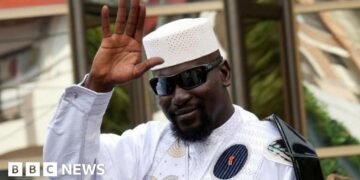























Guinea’s Junta Leader Gen Mamady Doumbouya Claims Presidential Election Victory Amid Controversy
Gen Mamady Doumbouya, the leader of Guinea’s military junta, is reportedly leading in the presidential election that unfolded after key opposition candidates were barred from participation. This election is a crucial moment for Doumbouya as he seeks to establish legitimacy following a coup that deposed the previous government four years prior.
The implications of this election are significant, as it brings to the forefront ongoing tensions between the ruling military regime and various civil society groups advocating for a return to civilian governance. Critics have denounced the election process, suggesting that it lacks credibility and fair representation, which raises concerns about the future of democracy in Guinea.
Key Developments
- Gen Doumbouya is reported to have won more than 80% of the votes in many districts of the capital, Conakry.
- The election faced criticisms from civil society groups, labeling it a “charade,” and citing irregularities raised by opposition candidates.
- Social media access was restricted on platforms like TikTok, YouTube, and Facebook as results awaited, raising concerns about attempts to suppress public dissent.
- Eight candidates participated, but major opposition parties were not included, rendering the electoral landscape heavily unbalanced.
- Doumbouya previously committed not to run for office following his rise to power but later reversed this decision after a new constitution allowed his candidacy.
Full Report
Election Results and Reactions
According to early electoral results announced on television by Djenabou Toure, the head of the General Directorate of Elections, Gen Doumbouya has won an overwhelming majority in numerous districts, particularly in Conakry, where he garnered more than 80% of the vote. His strong performance extended to other regions such as Boffa, Fria, Gaoual, Koundara, Labe, and Nzerekore.
Controversial Campaign Atmosphere
The election environment has been criticized by civil society groups and opposition figures. As citizens awaited full election results, internet monitoring groups, such as NetBlocks, observed restrictions on social media platforms—a move perceived as an effort to limit criticism against the junta’s actions and election outcomes.
Promises Broken
In a noteworthy turn, Doumbouya had pledged not to seek the presidency following the 2021 coup that ousted 83-year-old President Alpha Condé. At the time, he emphasized the importance of maintaining his promises as a military leader. However, the recent constitutional changes enabled him to contest the election, marking a significant departure from his earlier vow.
Political Landscape
Although Doumbouya enjoys popularity among many young citizens in Guinea, he faces significant scrutiny regarding his government’s restrictive measures on opposition activities, including a ban on protests and tightened press freedoms leading up to the elections. Critics allege that these actions reflect the same grievances that prompted Doumbouya to take power from Condé, which included allegations of corruption and economic mismanagement.
Context & Previous Events
Gen Doumbouya’s rise to power came in September 2021 when he led a coup against President Alpha Condé. Following the coup, Doumbouya assured the public that he would not become a candidate for the presidential office, committing instead to restore civilian governance. However, with the recent election and his new candidacy, many see a shift in his earlier stance.
Despite Guinea’s wealthy mineral reserves, including bauxite and iron ore, more than half of the population continues to live in poverty, a situation that underscores the longstanding economic challenges in the nation.