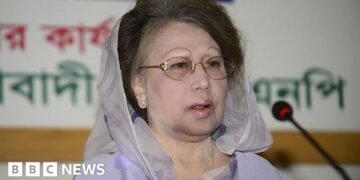























Khaleda Zia: Bangladesh’s First Female Prime Minister Passes Away at 80
Khaleda Zia, the first female prime minister of Bangladesh, has died at the age of 80. A significant political figure, Zia led the country during two separate terms and faced numerous challenges, including allegations of corruption and imprisonment before her eventual release.
Why It Matters
Zia’s death marks the end of an era in Bangladeshi politics, reflecting the tumultuous landscape of a country that has seen significant political strife. Her rise to power and subsequent challenges mirrored the broader struggles faced by women in leadership roles in South Asia. The future of her political party, the Bangladesh Nationalist Party (BNP), remains uncertain, particularly with her elder son, Tarique Rahman, viewed as a potential successor.
Key Developments
- Khaleda Zia served as prime minister from 1991 to 1996 and again from 2001 to 2006.
- She emerged as a key leader following the assassination of her husband, Ziaur Rahman, in 1981.
- During her tenure, she implemented policies to improve women’s education and made primary schooling free and mandatory.
- Zia faced multiple legal battles, including a five-year sentence for embezzlement, which she claimed was politically motivated.
- After a significant political shift in 2024, she was released from prison due to deteriorating health.
- Zia passed away on December 30, 2025, in Dhaka, following severe health complications.
Full Report
Early Life and Political Rise
Born in West Bengal in 1945, Zia moved to what is now Bangladesh with her family following the partition of India. She married Ziaur Rahman, a military officer involved in Bangladesh’s struggle for independence, when she was only 15. Following his assassination in 1981, Zia transitioned from a "shy housewife" to a formidable political leader.
Zia’s ascent in the Bangladesh Nationalist Party, where she served as vice chairman, came during a period of military dictatorship. Despite being placed under house arrest at times, she organized mass protests that ultimately led to the restoration of democracy.
Service as Prime Minister
In 1991, Zia became the first female leader of Bangladesh. Her government made strides in education, notably mandating free primary education, and introduced a constitutional amendment to reserve legislative seats for women. However, her first term ended in 1996 with a loss to rival Sheikh Hasina’s Awami League.
She returned to power in 2001, forming an alliance with Islamist parties, which significantly bolstered her parliamentary representation. Her reforms aimed at increasing female participation in politics and education highlighted her commitment to women’s issues.
Legal Troubles and Imprisonment
Following her second term, a political crisis ensued, leading to her resignation in 2006. Amidst accusations of corruption, she was arrested the following year. Legal battles continued for years, with her supporters alleging that the charges were based on political vendettas.
In 2018, Zia was convicted of embezzling funds and was sentenced to five years in prison. Despite her legal woes, she maintained her stance that the charges were politically motivated. Health issues resulted in her transfer to a hospital, and ultimately, she was released from prison on health grounds in 2024.
Final Years and Death
Zia’s health continued to worsen, leading to life-threatening conditions. Following the political upheaval that saw Sheikh Hasina’s government replaced in 2024, Zia was allowed to leave Bangladesh for medical treatment in London. She passed away in Dhaka on December 30, 2025, leaving behind her elder son, Tarique Rahman, who is seen as a potential leader for the BNP.
Context & Previous Events
Khaleda Zia’s political journey began after her husband’s assassination during a tumultuous period in Bangladesh’s history. Zia’s rise came at a time when her nation was transitioning from military rule to democracy. Her tenure was marked by fierce rivalry with Sheikh Hasina, culminating in a political environment rife with accusations and legal battles that defined Bangladesh’s political landscape for decades.