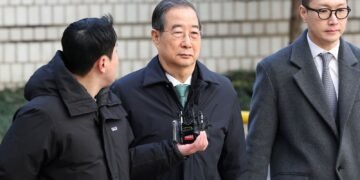























Former South Korean Prime Minister Sentenced to 23 Years for Role in Martial Law
A court in South Korea has sentenced former Prime Minister Han Duck-soo to 23 years in prison for his involvement in a failed martial law declaration in 2024. Convicted on charges including insurrection, Han is the first cabinet official to face legal repercussions directly linked to this controversial event.
Why It Matters
The sentencing of Han Duck-soo marks a significant moment in South Korea’s tumultuous political landscape, raising questions about governance, accountability, and democratic integrity. Han’s conviction represents an unprecedented legal action against a senior government official involved in efforts to impose martial law, stirring debates about the threats to democracy in a nation with a history of authoritarian rule.
Key Developments
- Han was found guilty of insurrection, perjury, and forgery by the Seoul Central District Court.
- His involvement included facilitating a cabinet meeting that supported the martial law declaration ordered by then-President Yoon Suk Yeol.
- The martial law lasted approximately six hours before being overturned by parliament amid public protests.
- Han, aged 76, intends to appeal the ruling, contesting all charges except perjury.
- Recent developments also include Yoon Suk Yeol being sentenced to five years in prison for related abuses of power.
Full Report
Court Findings
The Seoul Central District Court described Han’s actions as "engaging in the key action of insurrection." The judge criticized Han’s failure to uphold democratic principles, stating that he chose to ignore his responsibilities despite having been granted democratic legitimacy. The court expressed concern over the potential risk of South Korea sliding back into an authoritarian regime.
Immediate Reactions
Following the verdict, Han stated he would "humbly follow" the judge’s decision, but his legal team plans to appeal. While he acknowledged regrets regarding his inability to prevent the martial law declaration, he denied any involvement in supporting it, asserting that he never consented to the president’s order.
Broader Implications
The court’s decision comes shortly after Yoon was impeached and subsequently sentenced, highlighting ongoing power struggles within South Korean governance. Han briefly served as acting president after Yoon’s impeachment but also faced political turmoil resulting in his resignation. The case underscores the instability and contentiousness of South Korea’s political arena, with former leaders facing serious charges that evoke memories of the nation’s authoritarian past.
Context & Previous Events
On December 3, 2022, the South Korean military was deployed following a controversial declaration of martial law by President Yoon Suk Yeol. The order was met with rapid opposition, and parliament voted to overturn it within hours. Han’s involvement in the lead-up to this declaration and the subsequent legal ramifications represent a critical juncture for South Korea’s political and democratic landscape, reflecting tensions between governance and the rule of law.