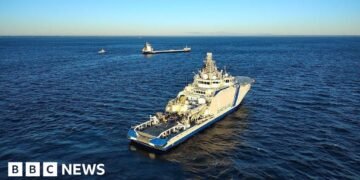























Finnish authorities have detained a cargo vessel linked to the damage of an undersea telecommunications cable that connects Helsinki and Estonia. The incident, which has raised concerns about national security and the potential for hybrid warfare, has led to the arrest of all 14 crew members aboard the vessel.
Why It Matters
The integrity of undersea cables is crucial for international communication and data transfer. Recent events have highlighted vulnerabilities in these infrastructures, particularly amid rising geopolitical tensions. This incident underlines the need for heightened vigilance regarding potential sabotage efforts, especially given the Baltic Sea’s strategic significance in the current geopolitical climate.
Key Developments
- A cargo vessel named Fitburg, sailing under the flag of St. Vincent and Grenadines, was detained by Finnish police.
- The vessel had been en route from St. Petersburg to Haifa, Israel, when it reportedly damaged a telecom cable owned by Finnish operator Elisa.
- All 14 crew members, comprising Russian, Georgian, Kazakh, and Azerbaijani nationals, have been arrested.
- Elisa confirmed that despite the damage, its services remained operational as rerouting was implemented.
- Authorities are investigating charges of aggravated disruption of telecommunications and sabotage.
- The Finnish Coast Guard dispatched a helicopter and patrol ship after Elisa detected the cable fault.
- Second cable connecting Estonia and Finland also experienced an outage; Estonia’s President expressed hope it wasn’t a deliberate act.
- The European Commission announced it is closely monitoring the situation and is prepared to counter potential hybrid threats.
Full Report
The Finnish police have taken control of the Fitburg as part of an ongoing investigation into “aggravated disruption of telecommunications,” as declared by Police Chief Ilkka Koskimäki. The action follows reports that the vessel was found dragging its anchor in the Gulf of Finland, which is known for its critical undersea infrastructures.
President Alexander Stubb emphasized Finland’s readiness for various security challenges and affirmed the authorities’ commitment to uncovering the facts behind the incident.
Following the cable damage, Elisa reassured users that its services had not been impacted and stated that it had rerouted traffic seamlessly to mitigate disruption. The police’s inquiry will delve into potential links between the damage and broader geopolitical tensions, although local law enforcement has refrained from speculating on motivations or foreign involvement.
Furthermore, Estonia’s government reported that another telecoms cable also experienced an outage on the same day, raising further alarms. President Alar Karis called for a thorough investigation to determine the cause of these outages.
Henna Virkkunen, the EU’s technology commissioner, highlighted that the European Commission is vigilant and prepared to address any hybrid threats that may arise as a consequence of this incident.
Context & Previous Events
The Baltic Sea has witnessed several incidents involving the damage or sabotage of undersea cables in recent years, prompting discussions about national security and the protection of critical infrastructures. The situation has gained renewed attention following Russia’s invasion of Ukraine in 2022, as experts and political leaders regard these incidents through the lens of broader hybrid warfare tactics.