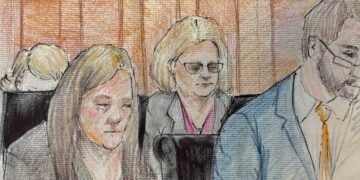























Milwaukee Judge Found Guilty of Immigration Obstruction
A federal jury has convicted Milwaukee County Circuit Court Judge Hannah Dugan of obstructing immigration enforcement, a case that underscores the contentious intersection of judicial authority and federal immigration policy.
This verdict could have significant implications for judicial conduct and immigration enforcement, particularly in a climate where courthouse access for federal agents is a subject of heated debate. Dugan’s actions will likely raise questions about the limits of judicial discretion amidst evolving immigration guidelines.
Key Developments
- Judge Hannah Dugan was found guilty of obstructing a proceeding against an undocumented immigrant.
- The undocumented individual, Eduardo Flores-Ruiz, was arrested outside the courthouse after a chase by immigration agents.
- Dugan faced two federal charges: obstruction of a proceeding (felony) and concealing an individual to prevent arrest (misdemeanor); she was acquitted of the misdemeanor charge.
- Prosecutors claimed Dugan facilitated an "escape route" for Flores-Ruiz, allowing him to exit through a restricted door.
- Assistant U.S. Attorney Kelly Watzka described the judge’s actions as a "round-up" of federal agents.
- Dugan’s attorneys argued her actions were influenced by the unclear immigration policies in effect at the time.
Full Report
Trial Findings
Judge Dugan’s trial concluded with a jury finding her guilty on one count of felony obstruction related to her actions during the attempted arrest of Flores-Ruiz. The defendant, a Mexican national, was in Dugan’s courtroom facing misdemeanor battery charges when the incident unfolded last April. Following a brief pursuit, Flores-Ruiz was apprehended outside the courthouse and has since been deported.
Testimony during the trial indicated that Dugan exhibited agitation upon approaching federal agents who were waiting to execute the arrest. Agents noted that she questioned whether they possessed a judicial warrant and redirected them to the chief judge’s office. Furthermore, she expedited the proceedings for Flores-Ruiz, allowing him to leave through a door typically reserved for jurors, leading to the public hallway.
Government’s Argument
In the prosecution’s closing statements, Assistant U.S. Attorney Watzka characterized Dugan’s behavior as intentionally obstructive, claiming she had arranged a means for Flores-Ruiz to evade federal law enforcement. Courtroom audio was presented in which Dugan stated she would "take the heat" for her actions, further indicating awareness of potential consequences.
Defense Claims
Dugan’s legal team contended that the immigration enforcement landscape at the courthouse was uncertain at the time, contributing to Dugan’s perceived missteps. They emphasized that once Flores-Ruiz exited through the jury door, he found himself in a public space and not hidden away. Dugan chose not to provide testimony during the trial.
The defense framed the case as a matter of judicial integrity, urging jurors to view their role as safeguards against government overreach. Dugan’s attorney, Jason Luczak, underscored the jury’s duty to deliver justice, framing the prosecution as unjust.
Context & Previous Events
The case shines a light on the impact of federal immigration policies introduced during the Trump administration, which expanded agents’ authority in courthouses, reversing a long-standing practice of keeping such sites off-limits. This policy shift has since spurred nationwide discussions regarding the balance of power between immigration enforcement and judicial independence, making Dugan’s conviction particularly relevant in current debates surrounding immigration law and judicial conduct.






