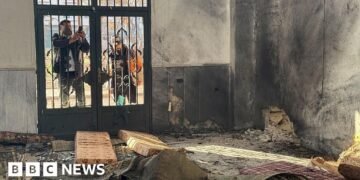























Explosion Rocks Homs Mosque, Claims Lives of Eight and Injures Eighteen
An explosion during Friday prayers at the Imam Ali ibn Abi Talib Mosque in Homs, Syria, has resulted in the deaths of at least eight individuals and injuries to eighteen others, according to the country’s health ministry. This attack, which officials believe involved explosives detonated within the mosque, underscores the ongoing instability in a region marked by sectarian tensions.
Why It Matters
This incident highlights the precarious security situation in Syria, particularly in areas with a diverse ethnoreligious composition. The attack not only reflects the resurgence of extremist violence but also raises concerns about the safety of minority groups in a post-conflict landscape. With the jihadist group Saraya Ansar al-Sunnah claiming responsibility, the event further complicates the already tumultuous atmosphere following years of civil strife and government crackdowns.
Key Developments
- An explosion during Friday prayers at a mosque in Homs has killed eight and wounded eighteen.
- The attack is attributed to the Sunni extremist group Saraya Ansar al-Sunnah, which claims to have collaborated with another unidentified group.
- Photos from the scene reveal significant damage, including scorched walls and bloodied carpets.
- The Syrian Foreign Ministry condemned the attack as a "terrorist crime" targeting human values and stability.
Full Report
Details of the Attack
The explosion occurred inside the Imam Ali ibn Abi Talib Mosque in the Wadi al-Dhahab neighborhood, predominantly inhabited by the Alawite community, an ethnic and religious minority in Syria. Images released by the state-run news agency Sana portray the ravaged interior, with walls charred and windows shattered. Preliminary reports suggest that explosives were deliberately planted within the mosque.
Claim of Responsibility
Saraya Ansar al-Sunnah has asserted responsibility for the attack, stating that it executed the operation in tandem with another unnamed group. This group has gained notoriety for prior assaults, including a deadly bombing at a church in Damascus claimed back in June. Observers suspect that Saraya Ansar al-Sunnah may be operating as a front for the Islamic State or have similar affiliations, given their targeting patterns and communication style.
Official Responses
The Syrian government has vehemently condemned the attack. A statement on the platform X characterized the incident as a blatant violation of moral standards aimed at destabilizing the country. This condemnation adds to ongoing fears among Alawite communities who have faced retaliatory violence since the ousting of Bashar al-Assad, their leader, following the uprising against his regime.
Context & Previous Events
Since the downfall of Assad, who is an Alawite, Syria has been plagued by renewed sectarian conflict, leading to fears among Alawite individuals of potential retaliation. Reports from the Syrian Observatory for Human Rights earlier this year indicated that security forces were implicated in the deaths of numerous Alawites in Latakia province. As the situation remains fluid, sectarian tensions continue to pose a threat to the fragile balance of peace in the region.