






















European Leaders Call for Multinational Force in Ukraine Following Peace Talks
European leaders are advocating for a "multinational force" to ensure Ukraine’s security following a prospective peace agreement with Russia, a significant development stemming from recent talks in Berlin. These discussions have fostered an optimistic atmosphere, bolstered by new U.S. commitments to provide security assurances to Ukraine.
Why It Matters
The emergence of a multinational force dedicated to Ukraine’s defense underscores the stakes involved in the ongoing conflict. With European nations and the U.S. rallying together, there is a concerted effort to not only facilitate peace but also to fortify Ukraine’s sovereignty and stability within the wider European context.
Key Developments
- Multinational Force Proposal: European leaders agreed on the need for a multinational force supported by the United States to secure Ukraine after a potential peace deal.
- U.S. Security Guarantees: German Chancellor Friedrich Merz described recent security commitments from the U.S. as “truly remarkable,” expressing high expectations for their role in negotiations.
- U.S. President’s Optimism: President Donald Trump stated that the parties are closer to achieving a ceasefire than ever before.
- Ukrainian Concerns: President Volodymyr Zelenskyy acknowledged the talks regarding territorial concessions to Russia as "painful" and affirmed the existence of differing positions.
- Claims of Military Actions: Ukrainian authorities reported a significant strike against a Russian submarine, a claim denied by Russian forces.
- Joint Statement: European leaders expressed appreciation for the collaboration between Ukrainian and U.S. officials and emphasized support for Ukraine’s EU membership.
Full Report
Multinational Security Force
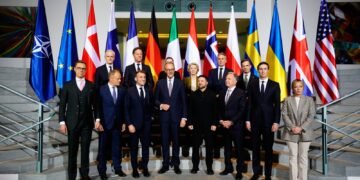
During a joint statement, leaders from Germany, Denmark, Finland, France, Italy, the Netherlands, Norway, Poland, Sweden, the UK, along with officials from the European Council and Commission, endorsed the proposal for a multinational force. This force would comprise nations from the "Coalition of the Willing" and operate under U.S. support.
Security Guarantees and EU Membership
The joint statement highlighted that leaders welcomed the intense collaboration between President Zelenskyy and President Trump, expressing consensus on achieving enduring peace, which would uphold Ukrainian sovereignty and enhance European security. They also reiterated their support for Ukraine’s potential accession to the European Union while allowing its military forces to maintain a strength of 800,000 personnel.
Reactions to Claims of Military Strikes
Ukrainian security officials asserted they had successfully targeted a Russian submarine valued at $400 million, a claim that was dismissed by Russian military officials. The Black Sea Fleet command claimed that no vessels or submarines were affected, casting doubts on the authenticity of Ukraine’s report.
Context & Previous Events
The Berlin talks took place over the course of two days and included discussions between Ukrainian envoy Steve Witkoff and U.S. envoy Jared Kushner, alongside a separate meeting of European leaders. These discussions followed an increasingly urgent need for a ceaseless resolution to the conflict, which has resulted in substantial loss and disruption since its inception.