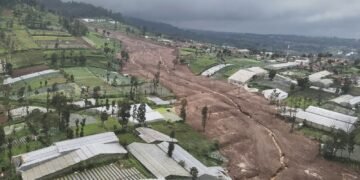























Landslide in West Java Leaves 72 Missing and 25 Confirmed Dead
A devastating landslide on Indonesia’s Java island has resulted in at least 25 fatalities, with search efforts still ongoing for 72 individuals believed to be trapped beneath layers of mud, rocks, and uprooted trees. The landslide, which struck West Bandung district during a period of relentless rain, has escalated concerns regarding environmental management in disaster-prone areas.
Why It Matters
This tragedy highlights the urgent need for effective land-use policies in Indonesia, particularly in regions prone to natural disasters. With climate change causing increasingly extreme weather events, the interplay between environmental degradation and increased vulnerability is under sharp scrutiny.
Key Developments
- Rescuers have recovered 14 additional bodies, bringing the total death toll to 25.
- Search operations continue for 72 individuals missing in the aftermath of the landslide.
- More than 30 homes in Pasir Langu village were completely buried.
- Authorities have evacuated around 230 residents to temporary shelters.
- Search efforts face challenges due to unstable terrain and potential additional rain.
Full Report
Search and Recovery Efforts
As rescue operations extend into a second day, improved weather conditions allowed a 250-member search team to recover more bodies. However, many rescuers are utilizing only basic tools, as heavy machinery remains ineffective on the soft, swollen ground. Chief of Basarnas, Mohammad Syafii, expressed that the terrain’s instability poses a significant challenge to operations. “With the area this wide, we’ll utilize every asset available, including drones and K-9 units, while prioritizing safety,” he stated.
Impact on Residents
In the Pasir Langu village, more than 30 homes have been swallowed by the landslide, leaving numerous families displaced. Emergency shelters have been set up to accommodate around 230 evacuees. Local authorities are under pressure to address the factors leading to the disaster, especially in terms of land management policies.
Environmental Concerns
Environmental advocates argue that the landslide is a consequence of years of neglect regarding land-use regulations, emphasizing the connection between development and environmental degradation. Wahyudin Iwang from the environmental group Walhi West Java stated that the incident was indicative of broader neglect in planning, particularly in the North Bandung Area, which plays a crucial role in water catchment and ecological balance. “This landslide is the accumulation of activities that were not in line with spatial planning and environmental functions,” he noted.
Context & Previous Events
This landslide follows a string of similar natural disasters across South and Southeast Asia, including significant floods and landslides that resulted in over 1,300 deaths just two months earlier. In January 2023, Central Java also experienced deadly floods and landslides, further illustrating the country’s vulnerability to climate-related disasters.
Indonesia, which consists of over 17,000 islands, faces recurring flooding and landslides during the rainy season spanning from October to April, making effective environmental policy an urgent priority.