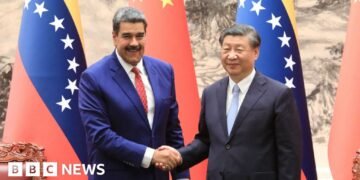























China Faces New Challenges in Venezuela Following Trump’s Bold Move
Recent events have upended the longstanding relationship between China and Venezuela, raising questions about the future of both nations’ diplomatic and economic ties. Following U.S. actions that saw Venezuelan President Nicolás Maduro arrested, China’s carefully cultivated presence in the oil-rich nation is now at significant risk.
Why It Matters
The U.S. push against Maduro signals a pivotal moment for China, which has invested heavily in Venezuela over the past two decades. As tensions escalate between the U.S. and China, how Beijing navigates this evolving landscape could impact not only its strategy in South America but also its broader ambitions on the global stage.
Key Developments
- Donald Trump’s recent actions against Maduro were swiftly condemned by China, which characterized them as a violation of Venezuela’s sovereignty.
- Despite the tension, China is cautiously reassessing its strategy in Latin America, where its economic investments have been substantial.
- U.S. Secretary of State Marco Rubio asserted that the Western Hemisphere should remain free from adversaries, hinting at increased U.S. involvement in the region.
- In the wake of Trump’s move, Beijing has expressed concern over the safety of its investments, which include over $100 billion in loans provided to Venezuela since 2000.
Full Report
Arrest of Maduro
In a dramatic turnaround, Nicolás Maduro found himself handcuffed and blindfolded, just hours after praising Chinese President Xi Jinping. The sudden shift in circumstances highlights the fragility of international alliances and exposes vulnerabilities in the extensive agreements between Beijing and Caracas, which encompass about 600 existing deals.
China’s Response
China quickly condemned the U.S. for what it labeled "bullying tactics" that infringe on Venezuela’s sovereignty. The Chinese Foreign Ministry underscored the importance of protecting every nation’s sovereignty under international law. This stern public stance illustrates China’s intent to position itself as a champion of sovereign rights, especially in the face of U.S. dominance.
Economic Implications
China’s economic relationship with Venezuela has been symbiotic: China’s growing energy needs were met by Venezuelan oil shipments, while Venezuela received crucial funding for infrastructure. Currently, around 80% of Venezuelan oil goes to China, but it only accounts for 4% of China’s total oil imports, placing both nations at risk if upheaval continues.
Chinese firms like CNPC and Sinopec heavily invest in Venezuela. If U.S.-backed actions lead to the nationalization of these assets, the potential fallout could dissuade future investments from Chinese enterprises. Experts caution that Chinese investors must now carefully weigh the risks associated with U.S. intervention before committing to new ventures.
Strategic Calculations
Beijing has historically demonstrated patience in its approach to international relations. As the U.S. asserts its influence in newly volatile regions, China faces a crucial period of reassessment. The failure in Venezuela could raise alarms about future investments and geopolitical strategies, particularly as China seeks to maintain its presence in a critical resource-rich region.
Context & Previous Events
For over two decades, China has established a robust partnership with Venezuela, characterized by extensive financial investments aimed at bolstering the Venezuelan economy through infrastructural developments. This relationship provided Venezuela with essential cash flow while fueling China’s growing energy demands. However, the complex dynamics of the U.S.-China relationship, exacerbated by recent events involving Maduro, could signal a turning point in their long-standing cooperation. The emergence of the U.S. as a formidable competitor in South America complicates Beijing’s ambitions, prompting a need for strategic recalibration.