






















Whisky Dispute Tests Canadian Unity Amid US Tariffs
A brewing conflict between Ontario and Manitoba over a popular Canadian whisky brand is testing the strength of a unified “Team Canada” approach in the face of U.S. tariffs. The situation escalated when Diageo, the British-owned company behind Crown Royal, announced plans to close its Ontario bottling facility, prompting an emotional response from Ontario Premier Doug Ford, who has vowed to boycott the product.
Why It Matters
This dispute highlights the complexities of interprovincial relations in Canada, especially during a time when the country faces significant economic challenges, including U.S. tariffs. The implications of the conflict extend beyond whisky production, with potential ramifications for employment and trade relations between provinces.
Key Developments
- Diageo announced plans to close its Amherstburg, Ontario facility, shifting some bottling operations closer to U.S. consumers.
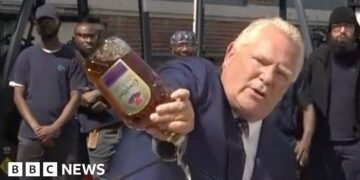
- Ontario Premier Doug Ford publicly criticized Diageo, pouring out a bottle of Crown Royal during a press conference and calling for a boycott of the whisky.
- Manitoba Premier Wab Kinew urged Ford to reconsider his stance, emphasizing the economic importance of the Gimli distillery for local employment.
- Kinew referred to his optimism for a resolution despite Ford’s current position, advocating for a cooperative approach amidst u.s. trade challenges.
- Ford has pledged to remove Crown Royal from Ontario liquor stores, a move that could adversely affect workers across Canada.
- Unifor, the union representing workers at the Amherstburg plant, fully supports Ford’s confrontation with Diageo, while the United Food & Commercial Workers criticized the boycott.
Full Report
Ontario’s Bold Stand
Following Diageo’s announcement about the closures, Premier Ford took a dramatic step, publicly disposing of Crown Royal whisky to express his outrage. He criticized the company’s management, calling them "dumb as a bag of hammers," and called on consumers to stop purchasing the product from Ontario liquor stores.
Ford’s actions are deeply rooted in his ongoing campaign against U.S. tariffs, which he believes are detrimental to Ontario’s economy. He has a reputation for being combative about trade issues, and this whisky dispute appears to have intensified his efforts.
Manitoba’s Alarm
Premier Kinew of Manitoba, facing the potential economic fallout of Ford’s boycott, made a symbolic visit to the Gimli distillery, which plays a crucial role in the local economy. He warned that Ford’s actions could inadvertently harm other Canadian workers and stressed the need for unity in facing external economic pressures.
Kinew remains hopeful that dialogue can resolve the discord, inviting Ford to Manitoba to discuss the matter, perhaps over a hockey game, though Ford has declined the offer.
Union Reactions
Reactions from labor unions have been mixed. Unifor National President Lana Payne praised Ford’s move as an appropriate response to protect jobs, asserting that this is how one should address trade disputes. Conversely, the United Food & Commercial Workers have condemned Ford’s public displays as harmful and unnecessary stunts that threaten the livelihoods of workers at Diageo’s facilities elsewhere in Canada.
Context & Previous Events
The conflict traces back to August when Diageo first indicated the closure of the Amherstburg plant, a change that would shift bottling operations to a new facility in Quebec. This restructuring is designed to enhance the efficiency of the company’s North American supply chain, sparking the recent public confrontation between provincial leaders. Crown Royal, first introduced in 1939 during a royal tour, has since become one of Canada’s most recognized whisky brands, making the stakes of this dispute particularly high for both provincial economies.