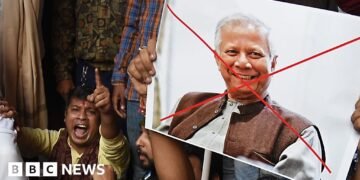























Escalation of Tensions Between India and Bangladesh Following Hindu Worker’s Killing
Protests in India over the murder of a Hindu garment worker in Bangladesh have deepened the diplomatic rift between the two neighboring countries. This incident highlights rising anti-India sentiment in Bangladesh and raises questions about the stability of their historically close relationship.
Why It Matters
The ongoing violence and diplomatic accusations could jeopardize the fragile peace and security within South Asia. With both nations accusing each other of exacerbating regional tensions, the situation presents serious implications not only for their bilateral relations but also for minority rights and communal harmony within Bangladesh.
Key Developments
- A Hindu man, Dipu Chandra Das, was killed by a mob in Bangladesh following accusations of blasphemy amid violent protests over a political murder.
- Protests in India have been organized by Hindu nationalist groups in response to the incident.
- Bangladesh has suspended visa services for Indian nationals in several cities, including the capital, Dhaka, amidst heightened security concerns.
- Diplomatic tensions escalated as both nations summoned each other’s high commissioners to address security issues related to their respective diplomatic missions.
- Videos of Das’s brutal killing were widely circulated on social media, inciting outrage in both countries.
- Bangladesh’s interim government has promised accountability for those involved in the killing while facing criticism for rising mob violence.
Full Report
Incident Overview
The lynching of Dipu Chandra Das, a 27-year-old garment worker and member of Bangladesh’s Hindu minority, has led to widespread unrest. Das was beaten to death in a mob attack last week in Mymensingh, further heightening communal tensions. His purported blasphemy against the Prophet Muhammad catalyzed the violence, with videos of the act circulating online, inciting outrage across borders.
Diplomatic Repercussions
Amidst the chaos, both countries have engaged in blame-shifting, accusing each other of failing to secure their diplomatic missions. Protests erupted in India, driven by Hindu nationalist groups demanding justice for Das and voicing anti-Bangladesh sentiments. Concurrently, Bangladesh’s police have denied confirmation that a suspect in the recent protests has fled to India, a claim made by supporters of a murdered student leader.
Recognizing the rising tensions, former Indian high commissioner to Dhaka, Riva Ganguly Das, expressed concerns over escalating violence, emphasizing the unpredictable nature of the current political landscape.
Prevailing Sentiments
Anti-India sentiment has been simmering in Bangladesh for years, particularly during the previous leadership of Sheikh Hasina. Many Bangladeshis have long viewed India as an overbearing neighbor, and recent events have amplified these feelings. Provocative statements from some young Bangladeshi leaders have added fuel to the fire, further complicating diplomatic relations.
In India, counter protests and rallies have sparked outrage in Bangladesh. A recent protest by a Hindu group outside the Bangladeshi embassy was denounced by Dhaka as “unjustifiable.” Experts suggest that the atmosphere of mistrust is unprecedented, with calls for both nations to uphold the diplomatic norms needed to safeguard their missions.
Government Response
Following Das’s death, Bangladesh’s interim government, led by Nobel laureate Muhammad Yunus, pledged to ensure accountability for the violence. However, they face scrutiny over their inability to maintain law and order during rising political tensions. There is growing evidence that radical elements within Bangladesh are exploiting this situation, targeting secular individuals, minorities, and entities they label as pro-India.
Context & Previous Events
The recent unrest follows a series of violent incidents and rising anti-India sentiment in Bangladesh, particularly since the ousting of Hasina. With the South Asian nation undergoing political turmoil and scheduled elections for February 12, the situation is fragile. The Awami League party faces a ban from participating in the elections, increasing the likelihood that the opposition, the Bangladesh Nationalist Party (BNP), will gain a stronger foothold. Concerns about the potential for violence remain, particularly as hardline religious parties seek to exploit anti-India sentiments for political gain.
Experts warn that the continuing cycle of violence primarily harms Bangladeshi citizens, especially minorities and secular-minded individuals, who stand in opposition to radical ideologies. As both nations navigate this complex landscape, the overarching need to stabilize their relationship remains urgent for the broader regional security framework.