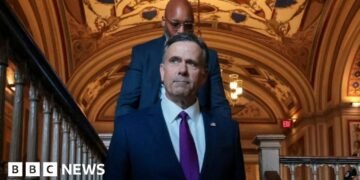























CIA Director Meets Venezuela’s Interim President Amid Shifting Dynamics
In a notable diplomatic maneuver, CIA Director John Ratcliffe met with Venezuela’s Interim President Delcy Rodríguez in Caracas. This meeting, taking place at the behest of President Trump, comes in the wake of the U.S. government’s recent seizure of former President Nicolás Maduro, with the aim of fostering trust and potential economic collaboration between the two nations.
Why It Matters
The meeting signifies a pivotal shift in U.S.-Venezuela relations, particularly as Venezuela grapples with a severe economic crisis and its position as the holder of the world’s largest proven oil reserves. The discussions touch on how Venezuela can pivot from a state often viewed as a haven for adversaries to a more cooperative economic partner with the United States.
Key Developments
- Ratcliffe’s meeting with Rodríguez lasted two hours, focusing on trust-building post-Maduro’s seizure.
- Rodríguez delivered her first state of the union address, signaling a shift in oil policy to invite foreign investment.
- The interim president asserted her willingness to engage diplomatically with the U.S., emphasizing Venezuela’s sovereignty.
- Trump has encouraged U.S. oil companies to invest $100 billion in Venezuela, despite industry concerns about the country’s current investment climate.
- Venezuela is introducing reforms to its hydrocarbon laws to attract foreign investments, departing from Maduro’s previous policies.
Full Report
Meeting Overview
On Thursday, CIA Director John Ratcliffe engaged in a landmark meeting with Venezuela’s Interim President Delcy Rodríguez, marking his inaugural visit to the country as a cabinet-level official. According to a U.S. official, the meeting was guided by President Trump’s directive to establish better communication channels following the recent U.S. operation that detained Maduro and his wife, Cilia Flores, on drug trafficking charges.
Economic Collaboration and Reforms
During the two-hour conversation, which served to build trust between the two parties, the participants discussed economic collaborations given the backdrop of foreign investment reforms being proposed by Rodríguez. In her first state of the union address, she announced intentions to reform Venezuela’s hydrocarbon laws, which have previously mandated that foreign partners work with state-owned PDVSA and hold a majority stake. The proposed reforms aim to facilitate investments in new oil fields and encourage a more favorable investment climate.
Rodríguez stressed the necessity for national unity to “wage the diplomatic battle” against the various challenges Venezuela currently faces. She conveyed her readiness to travel to Washington, if necessary, to engage directly with President Trump to advocate for her country’s best interests.
Responses and Future Outlook
President Trump indicated a strong interest in U.S. oil firms entering Venezuela, proposing that investment could ultimately help Venezuelans while also lowering energy prices in the U.S. However, some industry executives remained skeptical, with one noting that they consider Venezuela “uninvestable” without significant systemic changes. As the situation evolves, Trump has stated that the governance of Venezuelan oil sales would remain heavily influenced by the U.S.
Context & Previous Events
Rodríguez assumed the role of interim president on January 5 after Maduro’s apprehension by U.S. forces earlier that month. The charges against Maduro center around drug trafficking and related offenses. This political transition has occurred amidst a critical economic crisis in Venezuela, characterized by skyrocketing food prices and eroding purchasing power among its citizens. The proposed reforms come as both U.S. investors and government officials express interest in Venezuela’s vast oil reserves, highlighting a potential turnaround for the troubled nation.