






















Nativity Scenes Spark Controversy Amid Immigration Debate
Evanston, Illinois—Nativity scenes across suburban Chicago are at the center of a heated debate, with some churches using their holiday displays to comment on federal immigration enforcement under the Trump administration. The crèches are reimagined to reflect the plight of immigrant families as many face separation and deportation, causing both admiration and outrage among community members.
Why It Matters
As immigration policies intensify, these altered depictions of the Holy Family highlight contemporary issues faced by many in immigrant communities. The displays aim to evoke emotional responses while emphasizing the shared humanity of those affected by current laws. This intersection of faith and activism raises questions about the role of religious institutions in political discourse.
Key Developments
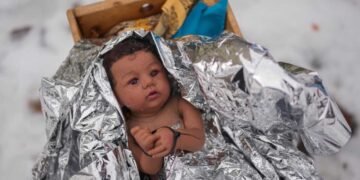
- A Nativity scene at Lake Street Church features baby Jesus wrapped in an emergency blanket and zip-tied, with Mary depicted in a gas mask and surrounded by Roman soldiers labeled "ICE."
- In another suburb, the Urban Village Church’s sign reads, "Due to ICE activity in our community the Holy Family is in hiding," referencing nearby immigration enforcement.
- Baby Jesus was removed from a Nativity scene at St. Susanna Parish in Dedham, Massachusetts, alongside a sign stating, "ICE was here."
- Supporters argue that these portrayals are rooted in biblical themes of refuge and hope, while critics deem them sacrilegious and politically charged.
Full Report
Church Displays and Community Reactions
Church leaders assert that these altered Nativity scenes serve as a means to address urgent societal issues. Rev. Michael Woolf of Lake Street Church emphasized the importance of public art during Christmas as an opportunity to make a statement. Historically, other congregations have also reworked their Nativity displays to highlight various issues, including environmental concerns.
At St. Susanna, parishioners previously used Nativity imagery to protest family separations at the border, demonstrating a commitment to using faith as a platform for advocating social change. However, this year, Archbishop Richard Henning ordered the dismantling of a contentious display, stressing that churchgoers should encounter authentic opportunities for worship, not divisive political messages.
Advocacy vs. Criticism
Some Catholic activists have called for consequences against clergy involved in the displays. C.J. Doyle from the Catholic Action League labeled the Nativity scenes a "grave scandal," suggesting possible disciplinary actions against church leaders. Others argue the displays merely reflect the realities faced by many parishioners, who live in fear due to an increase in ICE raids, claiming that the political aspects are indeed rooted in the Gospel.
Phil Mandeville, a member of St. Susanna’s Parish Council, clarified that their Nativity display is not a mere publicity stunt but a sincere reflection of their work with refugee families. He stressed the priority is to represent humanity rather than engage in political theatrics.
Community Support & Dissent
The controversy has not only attracted local attention but also involvement from other faith communities. Volunteers from a nearby synagogue gathered outside Lake Street Church to ensure the safety of worshippers during the protests. Meanwhile, reactions at St. Susanna varied—some parishioners supported the displays while others expressed disapproval, arguing that the church should focus on spiritual matters rather than political divisions.
Context & Previous Events
In prior years, churches have utilized Nativity representations to spotlight issues such as climate change and family separations resulting from immigration policies. Notable incidents include a display showing Jesus locked in a cage in 2018 to critique family separation practices. The ongoing debate surrounding religious symbols and their intersection with political activism continues to evolve in light of these recent events.






