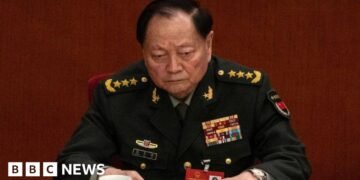























Purge of Senior Generals Raises Questions About PLA’s Stability
The recent ousting of China’s top general, Zhang Youxia, and another senior officer, Gen. Liu Zhenli, has left the senior ranks of the People’s Liberation Army (PLA) in disarray and raises significant concerns regarding the future of China’s military capabilities. This unprecedented purge signals a troubling shift that may impact not only the PLA’s command structure but also Beijing’s ambitions in Taiwan and broader regional stability.
Why It Matters
The removal of these high-ranking officials underscores a potential power struggle within China’s military hierarchy, raising fears about both leadership stability and the effectiveness of China’s military forces. With ongoing tensions over Taiwan, the implications of this turmoil could ripple across the region and affect Beijing’s decision-making regarding military actions.
Key Developments
- The Central Military Commission (CMC) has been reduced from a seven-member body to just two members: President Xi Jinping and Gen. Zhang Shengmin.
- Zhang Youxia, the 75-year-old former vice-chairman of the CMC, and Gen. Liu Zhenli were placed under investigation for "serious violations of discipline and law," a term often associated with corruption in Chinese politics.
- Analysts note that the purge reflects both a crackdown on corruption and the consolidation of Xi’s power within the military, though it raises questions about the PLA’s operational capacity.
- Speculation surrounds the reasons for the purge, with rumors ranging from espionage to internal coup plots, further highlighting the uncertainty and instability within the hierarchy.
Full Report
Implications for Military Leadership
The culling of Zhang and Liu represents a dramatic shift within the CMC, which is tasked with overseeing millions of military personnel. Experts indicate that the current leadership void could hinder strategic military decisions during a critical period for China. "The PLA is in disarray," noted Lyle Morris from the Asia Society Policy Institute, pointing to a significant leadership gap that could impact the military’s efficacy.
Corruption or Power Struggle?
While the official narrative cites corruption as the basis for the investigation, many analysts emphasize the potential for underlying power dynamics at play. The CMC has historically served as a platform for both military oversight and political maneuvering. The sudden removal of Zhang, who had longstanding ties to Xi, raises questions not just about corruption but about loyalty and political positioning—elements critical to Xi’s consolidation of power.
Impact on Taiwan Relations
With China increasingly focused on Taiwan, the internal unrest raises critical questions about strategic military planning. Some analysts argue that the removals may affect decision-making related to Taiwan, concentrating military judgments further into Xi’s hands. "The purge may matter for operational decisions," stated Associate Professor Chong Ja Ian, suggesting that the lack of seasoned military leaders may complicate matters regarding escalation tactics toward Taiwan.
Context & Previous Events
Prior to these recent developments, Xi Jinping had prior established a firm grip on power through a sweeping anti-corruption campaign, which critics argue has also served to eliminate political rivals. The military atmosphere under Xi has shifted significantly, with a climate of suspicion potentially leading to weakened decision-making capabilities. The PLA has faced scrutiny for its internal operations amid escalating tensions in the Taiwan Strait, making this latest upheaval all the more consequential.