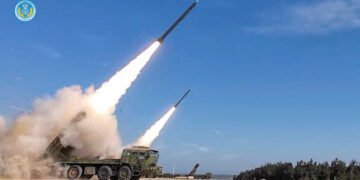























TAIPEI, Taiwan (AP) — China’s People’s Liberation Army has intensified its military presence around Taiwan, conducting a second day of extensive drills dubbed “Justice Mission 2025.” The exercises, featuring live fire, aimed to underscore Beijing’s commitment to thwarting any foreign support for the island it regards as part of its sovereign territory.
Significantly, Taiwanese officials reported that some of China’s live rounds landed closer to the island than in previous drills, a disturbing development as the geopolitical climate escalates.
Why It Matters
The situation around Taiwan is increasingly precarious, with military drills serving not only as a show of force but also impacting civilian life. As tensions between China and Taiwan have historically drawn in global powers like the United States, these escalations could have far-reaching implications for regional stability, international relations, and economic activities—including air travel.
Key Developments
- Chinese military drills on December 30 and 31 involved live-fire exercises and the deployment of various military assets around Taiwan.
- Taiwan’s Civil Aviation Administration was informed of seven temporary restricted zones, affecting over 150 flights.
- Over 130 aircraft and naval vessels were detected around Taiwan, with many crossing the median line of the Taiwan Strait.
- Taiwanese officials acknowledged the landing points of some rockets fell within its 24-nautical-mile territorial waters, indicating a heightened level of provocation from China.
- The drills sent a clear warning to Taiwan and its international supporters, with China emphasizing its readiness to counter any perceived threats.
Full Report
Live-Fire Exercises
The PLA’s Eastern Theater Command executed extensive operations that included destroyers, frigates, and air support aimed at testing sea-air coordination capabilities. These actions, along with long-range live-fire drills targeted at waters north of Taiwan, were aimed at demonstrating military readiness.
Impact on Civilian Activities
The Taiwanese Civil Aviation Authority reported significant disruptions to air travel due to the military drills, with more than 150 flights experiencing delays or cancellations amid safety concerns stemming from the exercises. Some of the affected flights were international, underlining the broader implications of rising military tensions.
Military Observations and Responses
Taiwan’s Defense Ministry noted a substantial increase in military activity around the island, including 130 aircraft and various ships detected on December 30-31. Many of these aircraft crossed the median line, indicating a more aggressive posturing from China. Taiwanese forces maintained readiness through increased monitoring and deployments of their own military assets in response.
Statements from Officials
Taiwan’s President Lai Ching-te condemned the drills and pledged a responsible approach to avoid escalating the situation further. Meanwhile, a spokesperson for China’s Defense Ministry declared that the drills served as a stern warning to “Taiwan independence” forces and foreign supporters, although specific nations were not mentioned.
Economic Consequences
The ongoing drills have had tangible economic ramifications for local fishermen, who report being forced to cease activities due to safety concerns. The chairman of the Keelung District Fishermen’s Association noted that the inability to fish has led to significant economic losses among members of his community.
Context & Previous Events
China and Taiwan have been governed separately since 1949, following a civil war that established the Communist Party in Beijing while the Nationalist forces retreated to Taiwan. In recent months, relations have soured further due to military posturing and increased arms sales from the U.S. to Taiwan, a point that has strained China’s relations with both Taiwan and the international community.






