






















National Guard Deployments Under Trump Could Top $1.1 Billion This Year
In a striking revelation from the Congressional Budget Office (CBO), the ongoing deployment of National Guard troops under President Trump could result in costs reaching $1.1 billion this year. This financial burden arises primarily from deployments aimed at managing protests in several Democratic-led cities, raising concerns over the efficient allocation of taxpayer money.
Why It Matters
The potential $1.1 billion expenditure on National Guard operations highlights a significant diversion of federal resources from critical areas such as healthcare and education. As cities grapple with pressing social issues, the debate surrounding the use of military forces domestically underscores the broader implications for public safety and governmental spending priorities.
Key Developments
- The CBO reports that current levels of National Guard deployments will incur an additional $93 million monthly.
- A projected $660 million is expected to be expended in Washington, D.C., alone, if current troop levels are maintained through December.
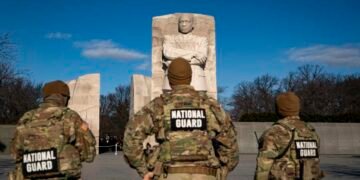
- Ongoing military presence includes locations in Washington, D.C., Memphis, and New Orleans, with over 2,690 Guard members deployed in D.C. specifically.
- The CBO conducted this analysis following requests from a group of 11 U.S. senators, led by Democratic Sen. Jeff Merkley of Oregon.
- The military presence has faced legal challenges, raising questions about morale and the operational efficacy of the National Guard in these roles.
Full Report
Financial Implications
The CBO’s findings indicate a substantial financial impact from the Guard’s domestic deployments. If the current troop levels continue, the financial obligations could reach $1.1 billion by year’s end. Specifically, the operation in Washington, D.C., is projected to cost around $660 million, based on an estimate of $93 million in monthly expenses. These expenditures reflect a broader trend where the nation’s defense budget could exceed $1 trillion for the first time.
Deployment History
President Trump first deployed National Guard members in June in Los Angeles, prompted by protests linked to immigration policies. This instigated a sequence of troop allocations to D.C., Memphis, Chicago, and Portland. Mobilizations aimed to tackle crime and secure federal properties, although the latter faced constraints from federal courts. Most recently, troops were positioned in New Orleans following a request for aid from local authorities.
The deployments represent significant financial resources, including approximately $496 million projected for 2025. The breakdown of costs indicates that Los Angeles will account for $193 million, D.C. $223 million, Memphis $33 million, Portland $26 million, and Chicago $21 million.
Perspectives on the Use of Guard Troops
Critics, including Gabe Murphy from Taxpayers for Common Sense, emphasize that employing National Guard forces for law enforcement isn’t financially viable, as their powers are limited, restricting them from performing essential policing activities. Murphy advocates for investing in community-based law enforcement as a more sustainable solution for crime reduction. Meanwhile, President Trump has maintained that the presence of the National Guard correlates with increased safety in affected cities.
Potential Future Costs
Should President Trump order additional troop deployments, the CBO estimates costs could escalate by $21 million for every additional 1,000 soldiers. This financial strain could lead to budgetary challenges affecting other military priorities, echoing concerns raised in 2021 when substantial funds used for Guard operations detracted from military readiness and training.
Context & Previous Events
In early January, the Trump administration withdrew Guard members from California, Oregon, and Illinois after the Supreme Court ruled against further deployments in Chicago. The history of these deployments underscores a contentious approach to addressing domestic issues and the operational roles of the National Guard, particularly in the wake of heightened civil unrest.






