
























Spanish Church and Government Reach Compensation Agreement for Abuse Victims
A significant deal between Spain’s Roman Catholic Church and the government aims to provide compensation for victims of sexual abuse by clergy members. This agreement addresses long-standing complaints regarding the Church’s handling of abuse cases and expands avenues for victims to receive reparations, particularly for incidents that occurred years ago.
Why It Matters
This agreement marks a crucial step in addressing the widespread allegations of sexual abuse within the Church, which have been inadequately managed in the past. With estimates suggesting that around 440,000 Spaniards have endured such abuse, the initiative not only seeks to compensate victims but also attempts to restore faith in institutional accountability within the religious community.
Key Developments
- The Spanish government will coordinate with the Church to manage compensation claims.
- Victims can seek reparations for cases that are beyond the statute of limitations or involve deceased perpetrators.
- Justice Minister Félix Bolaños underscored the importance of addressing what he termed a "historic, moral debt" owed to victims.
- The compensation system will include symbolic, psychological, or economic reparations, although specific financial figures are not yet disclosed.
- Critics have voiced concerns about transparency and the Church’s previous handling of abuse claims.
Full Report
Agreement Details
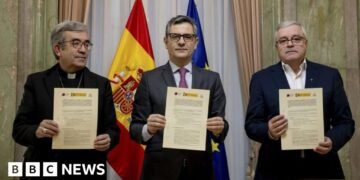
The recently signed agreement between Justice Minister Félix Bolaños, Luis Argüello (president of the Episcopal Conference), and Jesús Díaz Sariego (president of Confer) facilitates a structured approach for victims to seek redress. The new scheme allows victims to file claims with a fresh agency created by the justice ministry, which will then forward these cases to the ombudsman’s office to develop a compensation proposal. The Church is tasked with approving the proposed compensation, and if it does not comply, the case will revert to the ombudsman for further action.
Government and Church Responses
Minister Bolaños stated, "A democracy should not allow the existence of victims who have never been compensated," emphasizing the necessity of this initiative in confronting past injustices. Argüello described the agreement as a "step forward" in a journey toward accountability that the Church had long neglected. Sariego characterized the initiative as unprecedented, addressing crimes that had been overlooked due to the expiration of legal claims.
Victim Advocacy Reactions
Organizations advocating for victims have responded positively to the new agreement. Juan Cuatrecasas of the Association for Stolen Childhood expressed satisfaction, stating, "This is an endemic, structural evil… which we should have tackled a long time ago instead of covering up." However, critics remain wary of the Church’s intentions and previous lack of transparency regarding abuse claims.
Historical Context of Abuse Cases
The issue of sexual abuse within the clergy has been underreported in Spain compared to other countries. A recent study by the Spanish ombudsman’s office estimated that 1.1% of the population has experienced abuse from Church figures. The Church had previously established its own reparation scheme, but dissatisfaction with its structure led to the current collaboration with the government. Notably, the Vatican has taken a more active interest in facilitating reparations after victims’ groups severed ties with the Church, demonstrating a growing recognition of the need for accountability.
Context & Previous Events
Historically, sexual abuse allegations involving clergy have gained significant attention globally since the 1980s, particularly in the U.S., Canada, and subsequently in several countries including Ireland and Australia. Although Spain has had fewer notable scandals in the past, recent investigations have revealed disturbing patterns of abuse, prompting increased scrutiny and calls for action. The resignation of Cádiz bishop Rafael Zornoza amidst abuse allegations further underscores the urgency for the Church to confront its past.