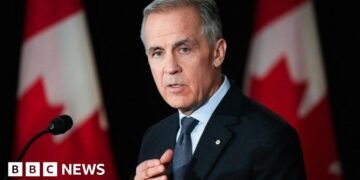























Mark Carney Stands Firm on Davos Speech Amid Trump’s Critique
Canadian Prime Minister Mark Carney has reinforced his stance from the recent World Economic Forum in Davos, where he raised concerns about the influence of unconstrained superpowers. This clarification comes after a Trump administration official asserted that Carney had retracted his comments during a phone conversation with President Donald Trump.
Why It Matters
This development highlights ongoing tensions between Canada and the U.S. regarding trade and foreign policy. As Canada navigates its relationship with both the United States and China, the stakes around international trade agreements and diplomatic discussions are significant for the future of North American relations.
Key Developments
- Carney confirmed that he maintained his original position from Davos during a phone call with Trump.
- U.S. Treasury Secretary Scott Bessent claimed Carney “aggressively” softened his remarks during the call.
- Carney stated that discussions with Trump covered various topics, including trade agreements and global security issues.
- Bessent criticized Canada’s recent trade negotiations with China, questioning Carney’s strategic approach.
- Trump has threatened Canada with potential tariffs if Chinese goods are allowed free access to the U.S. market.
Full Report
On Tuesday, Mark Carney addressed reporters in Ottawa, affirming his position from the Davos summit, where he indirectly criticized U.S. leadership for contributing to a “rupture” in the postwar global order. Carney stated unequivocally, “To be absolutely clear… I meant what I said in Davos,” confirming that he and President Trump had spoken directly about the issue.
Earlier, U.S. Treasury Secretary Scott Bessent had asserted on Fox News that Carney was “very aggressively walking back” his earlier comments. However, Carney rejected Bessent’s characterization of their conversation, noting it was President Trump who initiated the call on Monday. He described their discussion as productive, covering a range of topics, including the situations in Ukraine and Venezuela, Arctic security, and the newly negotiated trade agreement between Canada and China.
During their conversation, Carney also addressed the U.S.-Mexico-Canada Agreement (USMCA), emphasizing Canada’s proactive response to changes in U.S. trade policy. “Canada was the first country to understand the change in US trade policy that (Trump) had initiated, and we’re responding to that,” Carney remarked.
In his remarks, Bessent criticized Canada’s decision to pursue a trade deal with China, asserting that Canada significantly relies on U.S. trade, noting, “There’s much more north-south trade than there could ever be east-west trade.” He urged that Carney should prioritize Canadian interests over any perceived globalist agenda.
The tensions escalated when President Trump hinted at imposing 100% tariffs on Canadian goods if Canada allows Chinese products to bypass U.S. tariffs. As part of its agreement with China, Canada aims to reduce tariffs on canola oil substantially while taxing Chinese electric vehicles at a significantly lower rate than before.
Carney clarified that Canada is not actively negotiating a free-trade deal with China and emphasized that he views Trump’s tariff threats as part of a broader negotiation strategy regarding USMCA talks.
Context & Previous Events
Carney’s earlier remarks in Davos garnered significant media attention as he criticized the prevailing global dynamics and U.S. foreign policy under the Trump administration. The recent interaction reflects ongoing concerns about Canada’s trade strategy and its implications for U.S.-Canada relations in light of shifting global alliances.