






















upheaval in venezuela: trump’s bold claims and the uncertain fate of delcy rodríguez
President Donald Trump’s recent announcement regarding Nicolás Maduro’s detention has set the stage for a dramatic shift in Venezuela’s political landscape. In a surprise twist, Trump indicated the U.S. will oversee Venezuela until a “safe, proper and judicious transition” can be established, raising questions about the nation’s leadership and future direction.
Why It Matters
The stakes are significantly high as the U.S. seeks to orchestrate a transition in Venezuela, a country plagued by political turmoil and economic collapse. The announcements from both Trump and Maduro’s vice president, Delcy Rodríguez, highlight conflicting messages that could determine the future governance of Venezuela—a nation long beset by controversy and international scrutiny.
Key Developments
- Trump confirmed the detention of Maduro and indicated the U.S. would manage Venezuela during the transitional phase.
- Rodríguez claimed in a separate press briefing that Maduro’s arrest was a kidnapping, vowing that Venezuela would not become a U.S. colony.
- Under the Venezuelan constitution, Rodríguez’s rise as acting president seems logical, given her position as vice president.
- The U.S. had previously recognized Edmundo González as the legitimate president-elect after denouncing the alleged fraud of the 2024 elections.
- Rodríguez’s collaboration or defiance in the U.S. plan is crucial for a stable transition and poses the risk of internal conflicts within Maduro’s former government.
Full Report
Competing Messages
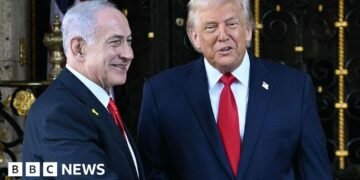
In a news conference, Trump stated: “We will run Venezuela until such time as we can do a safe, proper and judicious transition.” His comments came amid a backdrop of confusion as Rodríguez openly rejected the characterization of Maduro’s detention and urged the Venezuelan people to stand against foreign intervention.
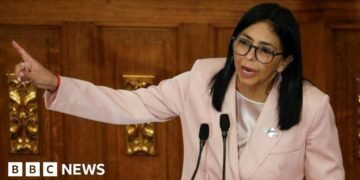
Rodríguez’s vehement condemnation of U.S. actions and her insistence on retaining Maduro’s legacy complicates the outlook for U.S. intentions in Venezuela. She firmly declared, “There is only one president in Venezuela, and his name is Nicolás Maduro,” countering Trump’s remarks about her willingness to cooperate with the U.S.
The U.S. Stance
Following the detention of Maduro, U.S. Secretary of State Marco Rubio indicated that discussions were ongoing with Rodríguez. He acknowledged that the Trump administration’s expectations would hinge on her actions, not merely her words. “If they don’t make the right decisions, the United States will retain multiple levers of leverage to protect our interests,” Rubio added.
Transition Challenges
As the current political structure remains intact, many observers are left questioning how Rodríguez will navigate leading Venezuela while meeting both the U.S. demands and expectations from Maduro’s loyalists. U.S. officials appear to favor continuity to avoid potential destabilization from a power struggle among Maduro’s close allies.
Contextual tension remains as Trump mentioned the possibility of further military action if deemed necessary, adding unpredictability to the circumstances under which an orderly transition could occur.
Context & Previous Events
The backdrop to this upheaval can be traced to widespread international condemnation of the 2024 Venezuelan elections, labeled fraudulent by a considerable number of nations, including the U.S. The Venezuelan electoral council, primarily composed of government loyalists, declared Maduro as president despite offering no credible voting tallies. Following this, González, supported by opposition leaders barred from running, gained recognition as the legitimate president-elect by the U.S. and several allies.
The past 18 months have seen leaders like María Corina Machado and González tirelessly campaigning for a transition of power, advocating for international backing amidst increasing crackdowns on opposition. Recently, Machado’s acknowledgment of the potential downfall of Maduro brought her back into media focus, yet she was publicly dismissed by Trump, further complicating the paths forward for those opposed to the current regime.
In summary, the political uncertainties in Venezuela remain convoluted, with Rodríguez’s impending choices set against an enduring backdrop of both local and international pressures. The course of future governance will heavily depend on her strategy to balance the conflicting demands placed upon her by external forces and internal loyalty.