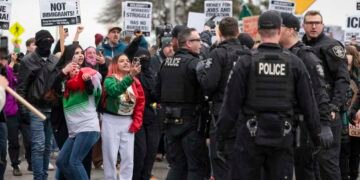























Bystander Videos Reshape Public Perception of Police Actions
Recent fatal incidents involving federal immigration agents have underscored the growing influence of bystander videos on public perception and discourse surrounding law enforcement. The tragic deaths of Alex Pretti in Minneapolis and Renee Macklin Good, along with extensive social media coverage, have heightened discussions about police accountability and transparency.
Why It Matters
Bystander videos, once a rare occurrence, have become vital tools for documenting controversial interactions between law enforcement and the public. This shift in technology allows the public to view events in real time, significantly impacting community response and government transparency. However, experts caution that these videos do not provide a complete narrative, raising concerns about interpretation and context.
Key Developments
- Federal immigration agents shot and killed Alex Pretti in Minneapolis on Saturday, with multiple recordings of the incident circulating online.
- Renee Macklin Good was also killed earlier this month by an ICE officer, sparking further scrutiny fueled by available footage.
- Experts note that videos posted on platforms like social media can shape public opinion and drive political protests.
- American public engagement with issues of police accountability has increased, with video evidence prompting more scrutiny towards governmental narratives.
Full Report
Impact of Bystander Videos
Bystander-recorded footage has become essential in the wake of high-profile incidents involving law enforcement actions. Experts, such as Darrell M. West from the Brookings Institution, emphasize that videos can convey immense information quickly, potentially altering public understanding. With the proliferation of smartphones, capturing and disseminating such footage has never been easier, allowing for widespread public engagement.
Federal Response and Public Sentiment
In response to these events, Minnesota Governor Tim Walz encouraged residents to document interactions with federal immigration agents, proposing that this could assist in establishing records for future legal actions. The growing accessibility of smartphones has enabled citizens to actively record significant moments, amplifying the visibility of contentious incidents.
Challenges of Interpretation
Despite their utility, experts warn that bystander videos may not fully represent events. They can be misleading, as viewer interpretations vary based on existing beliefs. Mary Beth Oliver from Penn State University highlighted that the context surrounding a video is critical for understanding, suggesting these clips can sometimes provoke misconceptions.
The Role of Social Media and AI
Researchers indicate that the rise of social media platforms has transformed the manner in which news is disseminated, making video evidence easily accessible to large audiences. However, with the increasing prevalence of technology such as artificial intelligence, distinguishing between authentic recordings and altered content may become more difficult, further complicating public trust in visual evidence.
Context & Previous Events
The impact of bystander videos is solidified by historical precedents. Notable incidents such as the 1991 beating of Rodney King by Los Angeles police, Oscar Grant’s death in 2009, and the killing of George Floyd in 2020 set important benchmarks in the use of video evidence to mobilize public opinion and initiate protests. As societal awareness of these occurrences has expanded, so too has the relevance of video evidence in conversations about race and policing.






