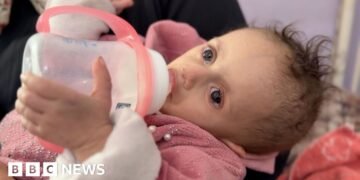

























One-Year-Old Palestinian Girl Returns to Gaza Hospital After Treatment in Jordan
A one-year-old Palestinian girl, Siwar Ashour, has returned to a Gaza hospital following a six-month medical treatment in Jordan for severe nutritional issues. Her repatriation raises urgent questions about healthcare accessibility in the war-torn region, as she faces a deteriorating health condition.
Why It Matters
Siwar’s case underscores the ongoing humanitarian crisis in Gaza, where medical facilities are on the brink of collapse due to extensive damage and shortages. Her situation highlights the difficulties faced by vulnerable populations in accessing essential medical care amid a protracted conflict. With hospitals overwhelmed, the plight of children like Siwar persists, casting a long shadow over the region’s future.
Key Developments
- Siwar Ashour was evacuated to Jordan in June due to severe nutritional problems and returned to Gaza on December 3 after treatment.
- She is currently receiving care for a gastro-intestinal infection at al-Aqsa Martyrs Hospital, where her health is worsening.
- Doctors report that poor hygiene conditions in hospitals are contributing to the spread of diseases among children in Gaza.
- The World Health Organization has characterized humanitarian needs in Gaza as “staggering,” revealing a critical shortage of medical supplies and infrastructure.
- Following Siwar’s return, her family faced challenges, including the confiscation of essential medical supplies by Israeli officials.
Full Report
Health Complications
Siwar Ashour was initially treated for severe malnutrition in Jordan but was sent back to Gaza after completing her treatment. Her grandmother reported that Siwar became ill just three days after her return, suffering from persistent vomiting and diarrhea. Dr. Khalil al-Daqran at al-Aqsa Martyrs Hospital noted that she has an immune deficiency, complicating her recovery and ability to absorb nutrients.
Despite receiving necessary treatment, Dr. al-Daqran emphasizes that Siwar’s situation remains critical. The hospital, like many others in Gaza, is struggling with an influx of child patients, having witnessed a threefold increase in admissions since a ceasefire took effect in October.
Conditions in Gaza
The healthcare infrastructure in Gaza has been severely compromised due to previous conflicts and ongoing hostilities, leading to a significant rise in infections and diseases, particularly among children. Dr. al-Daqran highlighted the dire shortages of medicines and medical supplies, as well as the lack of electric generators crucial for hospital operations.
The World Health Organization has responded to this crisis by calling for increased medical evacuations for patients unable to receive adequate treatment within Gaza, where humanitarian conditions are precarious.
Evacuation Politics
Upon her return from Jordan, Siwar’s family received a limited supply of hypoallergenic Neocate formula essential for her treatment. However, they reported that Israeli authorities confiscated most of these items, citing security concerns. The Israeli government clarified that only minimal luggage is permitted, a policy communicated to the Jordanian officials involved in the evacuation process.
This incident reflects the complex and often contentious nature of humanitarian aid within the context of the Israeli-Palestinian conflict. Dr. Mohammed al-Momani, Jordan’s Minister of Communications, stated that patients are returned only after completing their treatment, emphasizing that this policy aims to facilitate the evacuation of additional patients.
Context & Previous Events
Siwar was evacuated to Jordan in June under a medical program initiated by the Jordanian government, which has seen over 300 children and their guardians treated since March. The program has been crucial for many families unable to access specialized medical care due to the ongoing conflict.
The humanitarian situation in Gaza has been described as critical, with limited aid allowed into the region since Israel imposed a blockade last March. This blockade was partially lifted, but aid deliveries remain insufficient according to both the UN and various humanitarian organizations.