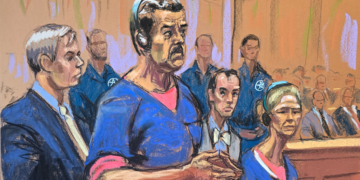























Nicolas Maduro and Cilia Flores Appear in U.S. Court on Multiple Charges
Nicolas Maduro, the former Venezuelan leader, and his wife, Cilia Flores, made headlines over the weekend after their capture by U.S. special forces. The couple entered a federal courtroom in New York City on Monday, facing serious charges that include federal narco-terrorism, drug trafficking, and firearms offenses. This high-profile case raises significant questions about U.S. foreign policy as it mirrors historical contexts, particularly the fall of Panama’s Manuel Noriega.
Why It Matters
The prosecution of Maduro and Flores marks a pivotal moment in U.S. foreign policy and its approach to regimes accused of narcotics-related activities. With this indictment, the Trump administration seems to be reaffirming its stance against international drug trafficking, emphasizing the U.S.’s commitment to legal action against those it deems a threat to national security.
Key Developments
- Maduro and Flores pleaded not guilty to the charges and waived their right to a speedy trial until at least mid-March 2026.
- The case is presided over by Judge Alvin Hellerstein, who has handled several significant narcoterrorism cases in the past.
- Former U.S. Attorney General Bill Barr indicated that new evidence may have emerged, potentially bolstering the prosecution’s case.
- Attorneys for both defendants signaled intentions to explore legal arguments concerning sovereign immunity, although experts assert these arguments are unlikely to succeed.
- Maduro and Flores are being held at a federal jail in Brooklyn, where they could face extensive trial procedures and a lengthy legal battle.
Full Report
Court Appearance and Charges
Nicolas Maduro and Cilia Flores appeared for their arraignment in a New York federal court on January 5, 2026. They are charged with multiple serious offenses related to narcotics and firearms. During the proceedings, both clients pleaded not guilty and opted to delay their right to a speedy trial.
Judge Alvin Hellerstein, who has a history of presiding over notable cases, including narcoterrorism convictions, oversees this trial. Reports suggest that evidence presented by former Venezuelan general Hugo "El Pollo" Carvajal, who pleaded guilty in a related case, could play a crucial role in the prosecution’s strategy.
Legal Representation
Barry Pollack, a defense attorney with experience in high-profile international cases, is representing Maduro, while Cilia Flores is defended by Mark Donnelly. Pollack has labeled the arrest as "an abduction" and plans to argue that Maduro’s sovereign status provides him immunity. Experts, however, suggest this defense may falter as the U.S. government does not recognize Maduro as the legitimate leader of Venezuela.
Prosecution Strategy
The U.S. Attorney for the Southern District of New York, Jay Clayton, led the indictment process against Maduro and Flores. Prosecutors are likely to use wiretaps and testimonies from cooperating witnesses to support their claims. Assistant U.S. Attorney Kyle A. Wirshba, who has previously dealt with significant narcotrafficking cases, represents the government in this matter.
Context & Previous Events
The current case against Maduro resembles historical instances of U.S. intervention in foreign drug-related matters, such as the prosecution of Manuel Noriega in the 1980s. In earlier legal matters similar to this one, the U.S. has often targeted foreign leaders implicated in drug trafficking.
Before this indictment, numerous high-profile figures connected to Maduro’s regime faced legal repercussions, reflecting a broader policy of the U.S. to address narcotrafficking at an international level.






