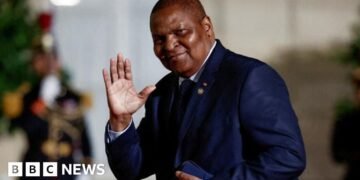























Central African Republic President Secures Third Term Amid Controversy
Faustin-Archange Touadéra has been re-elected as the President of the Central African Republic (CAR), garnering a decisive majority in the recent presidential election. This victory, confirmed by provisional results, raises significant questions about electoral fairness given the main opposition’s boycott of the polls.
This election and its aftermath are crucial as they highlight the ongoing instability in the CAR, a nation rich in resources yet plagued by conflict and deep-seated poverty. Observers have noted the implications of Touadéra’s continued presidency, especially regarding the influence of foreign powers, particularly Russia, in the country’s affairs.
Key Developments
- Touadéra won approximately 76% of the vote in the December 28 election.
- His main competitors, Anicet-Georges Dologuélé and Henri-Marie Dondra, received 15% and 3% of the vote respectively.
- Both challengers have called for an annulment of the election results, citing allegations of widespread fraud.
- The main opposition coalition boycotted the election, doubting its fairness.
- The Constitutional Court has until January 20 to address any challenges and produce final results.
Full Report
Election Results
The Central African electoral agency announced that Touadéra won with a significant majority, reflecting a predictable outcome after the opposition’s decision to boycott. With concerns around electoral integrity, this victory has been met with skepticism from his rivals, who claim the process was marred by manipulation and irregularities.
Opposition Response
Dologuélé and Dondra have openly contested the electoral process, alleging methodical attempts to influence the results in Touadéra’s favor. On a recent occasion, Dologuélé articulated that the poll lacked proper transparency and fairness. The allegations prompted responses from government officials, who have rejected the claims of misconduct.
Security and Governance Issues
Touadéra’s campaign emphasized achievements in security, a pressing concern in a country that has experienced ongoing turmoil since a rebel uprising in 2013. While previous peace agreements have helped stabilize parts of the nation, ongoing armed conflicts remain a significant challenge. The administration has relied on foreign military assistance to navigate this turbulent landscape.
International Dynamics
Experts suggest that Touadéra’s re-election might further entrench Russian interests in the CAR. The nation has become a key player for Russian security firms, particularly the Wagner Group, which has been active in providing military support while seeking resource access. The relationship presents both opportunities and potential risks for CAR’s governance and sovereignty.
Context & Previous Events
The Central African Republic has a prolonged history of instability, having faced a severe crisis since rebels ousted President François Bozizé in 2013. A peace deal in 2019 saw the government engage with numerous armed groups but failed to eradicate violence entirely. Currently, nearly half of the population relies on humanitarian aid amid this tumultuous backdrop of resource abundance and political strife.