






















U.S. Actions Toward Venezuela Spark International Law Concerns
In a striking development, Scotland’s First Minister John Swinney has suggested that the United States may have violated international law through its recent military operations in Venezuela, which resulted in the capture of President Nicolas Maduro. This assertion highlights a growing international debate over the legality of U.S. intervention in a sovereign nation amid significant geopolitical tensions.
Why It Matters
The implications of this situation extend beyond Venezuela. If Swinney’s claims are validated, they could challenge the legitimacy of U.S. foreign policy and military actions on the global stage. The differing responses from political leaders in the United Kingdom also underscore the complexities surrounding international law and state sovereignty.
Key Developments
- Military Action: U.S. airstrikes occurred early Saturday morning in Venezuela, leading to the capture of President Maduro and his wife, Cilia Flores, who were subsequently flown to New York.
- Legal Debate: Swinney emphasized that although Maduro’s regime is "illegitimate and authoritarian," it is unclear how the U.S. actions align with international law.
- Political Responses: UK Prime Minister’s stance remains cautious, while Sir Keir Starmer has indicated that the U.S. needs to provide justification for its actions, reiterating his commitment to international law.
- International Reactions: The U.N. Secretary-General expressed deep concern over the U.S. actions, stating that international law may not have been respected.
Full Report
Political Reactions
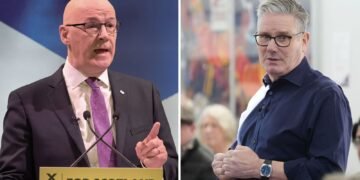
Scotland’s First Minister, John Swinney, voiced skepticism regarding the legality of the U.S. military operation in Venezuela. While acknowledging the ‘illegitimate and authoritarian’ nature of Maduro’s regime, Swinney questioned how international law could have been upheld in this context.
In contrast, UK Prime Minister’s position remains more reserved; he has adapted his comments slightly since the weekend but stops short of outright condemning Trump’s actions as illegal. Meanwhile, Sir Keir Starmer, leader of the Labour Party, noted the complexity of the situation and stated his long-standing advocacy for international law. As he articulated on Sky News, it is incumbent upon the United States to clarify its justifications for its military actions.
U.S. Military Actions
The U.S. launched airstrikes across Venezuela, resulting in the apprehension of Maduro and his wife, who were charges of narco-terrorism. President Trump asserted that the U.S. would continue to "run" Venezuela until a proper political transition occurs.
Internationally, reactions have been swift. All but one member of the European Union, Hungary, along with Canada and Norway, has called for adherence to international law regarding the U.S. actions. The United Nations has echoed these sentiments, with Secretary-General Antonio Guterres expressing deep concern over the situation.
Context & Previous Events
This event represents a significant escalation in U.S. foreign policy toward Venezuela, which has been marked by years of political and economic turmoil under Maduro’s leadership. Tensions have ramped up following various allegations against the Maduro government, including claims of corruption and connections to drug trafficking.
The U.S. intervention raises crucial questions regarding the principles of sovereignty and international law, particularly in a scenario where an authoritarian regime is in power. As global leaders respond, the implications of these actions may resonate throughout international diplomatic relations for years to come.