






















Tensions Rise as China Responds to U.S. Actions in Venezuela
In the wake of recent U.S. actions in Venezuela, China’s foreign relations are poised for reevaluation. President Donald Trump’s assertion that his operations in Venezuela would not adversely affect U.S.-China relations is now under scrutiny, as Beijing navigates a complex geopolitical landscape.
Why It Matters
China has long positioned itself as a staunch defender of non-interference in the affairs of sovereign nations. U.S. actions in Venezuela not only challenge this principle but also jeopardize China’s interests in Latin America, a region where it has significantly invested politically and economically. The implications of this situation could reshape diplomatic dialogues and alliances on a global scale.
Key Developments
- Trump’s declaration of non-impact on China’s relations with the U.S. contrasts sharply with Beijing’s official outrage.
- China’s relationship with Venezuela is marked by its significant investments and role as the largest importer of Venezuelan oil.
- Recent Chinese social media discourse has drawn parallels between Venezuela and Taiwan, questioning U.S. interventionist practices.
- Analysts indicate that, while China is expected to act swiftly to protect its interests, its dependency on Venezuelan oil may not be as critical as previously assumed.
Full Report
U.S. Operations and China’s Response
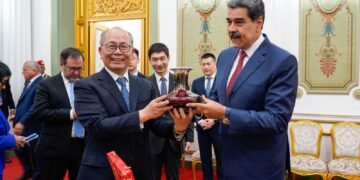
Following the U.S. capture of Venezuelan President Nicolás Maduro, Chinese officials slammed the action as a "clear violation of international law." The stance echoes China’s long-held doctrine that emphasizes respect for sovereign states. Beijing’s foreign ministry has publicly decried U.S. intervention, underscoring the embarrassment for China, given recent diplomatic interactions, including a visit from a high-ranking Chinese official just hours before Maduro’s capture.
Financial and Geopolitical Ramifications
While China is the largest buyer of Venezuelan oil, this transaction accounts for only about 4% of its total oil imports. Analysts note that China has pre-purchased substantial oil volumes, insulating it somewhat from immediate financial fallout. Historically, Maduro’s administration has depended on Chinese support more than vice versa, raising questions about the overall health of bilateral ties moving forward.
Social Media Reactions and Broader Comparisons
Chinese social media reflects a growing discussion surrounding the implications of U.S. actions, with users drawing comparisons to Taiwan’s status. Many wonder whether the U.S. precedent of unilateral detainment could apply similarly to China’s claims over Taiwan. However, experts caution that such reasoning may not lead to immediate military action.
China seems to be recalibrating its strategy, focusing on strengthening its position through pressure and diplomatic engagement rather than direct confrontation. The recent U.S. actions might serve as leverage for China to argue for greater global leadership, possibly prompting a reassessment of international reactions to its own activities.
Context & Previous Events
Historically, China has positioned itself as a defender of non-intervention, particularly in the context of its relationships within Latin America. The strategic partnership with Venezuela developed over years, marked by investments and imports that fortified economic ties. Trump’s increasing assertiveness on the world stage has demonstrated a significant shift in how nations are navigating the complexities of international law and sovereignty issues.