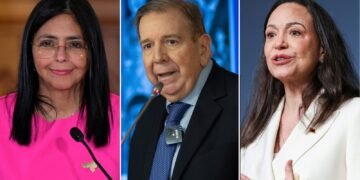























In the wake of Nicolás Maduro’s departure from power, Venezuela faces a critical juncture as it considers who will assume the presidency. While many speculate that Maria Corina Machado, a prominent opposition figure, could take the helm, substantial challenges remain in determining the nation’s true leadership.
Understanding Venezuela’s future is vital not only for its citizens but also for regional stability and U.S. interests. As the opposition gears up for potential governance, the legitimacy of the electoral process and the roles of key players like Delcy Rodriguez will significantly shape the country’s direction. The upcoming decisions hold vast implications for democracy and the rule of law in Venezuela.
Key Developments
- Maria Corina Machado, a leading opposition leader and recent Nobel Peace Prize laureate, has been vocal about the readiness of the opposition to govern.
- U.S. President Donald Trump stated that Machado may lack the necessary support within Venezuela and hinted at supporting Delcy Rodriguez as interim president.
- Edmundo Gonzalez, who was officially declared the winner of the contested 2024 election, is currently in exile in Madrid, complicating the transition.
- A Venezuelan constitutional lawyer asserted that according to the law, Gonzalez is the legally elected president.
Full Report
Leadership Questions Amidst Transition
The exit of Nicolás Maduro has sparked questions about who will lead Venezuela next. Maria Corina Machado, affectionately known simply as “Maria Corina,” is among the first names that arise as a potential successor. A strong advocate for opposition unity, she has publicly stated that the opposition is poised to take charge of the country. However, her candidacy for the 2024 elections has been blocked, pushing her to rally support around Edmundo Gonzalez, an untested former diplomat.
U.S. Influence and Political Dynamics
In a recent press conference, President Trump suggested that Machado might not command the respect or backing necessary for effective leadership. He indicated that the U.S. may play a significant role in Venezuela’s governance, possibly alongside Delcy Rodriguez, who has been ordered by the Venezuelan Supreme Court to step in as interim president. Trump noted their discussions, emphasizing the need for a leader that prioritizes the welfare of the Venezuelan people. This interventionist approach has sparked concern among some of Machado’s supporters.
The Role of Edmundo Gonzalez
Gonzalez is regarded by many, including international observers, as the legitimate victor of the 2024 election, which was marred by allegations of electoral manipulation by Maduro’s government. Following a well-coordinated effort by opposition parties to document the voting process, Gonzalez’s claim to the presidency stands stronger than the government’s assertions. Despite being in exile, he is expected to return to Venezuela to assume the presidency as mandated by the constitution.
Legal Framework and Path to Leadership
A constitutional expert noted that there is no legal pathway for Machado to ascend to the presidency, as Gonzalez’s term, beginning January 10, 2025, is set for six years. He could appoint her as vice president, but any transfer of power beyond that would take years and follow stringent legal processes.
Public Sentiment and Expectations
While Maria Corina remains a beloved figure among Venezuelans and has garnered international support, the local populace is eager for a transition conducted legally and constitutionally. Recent remarks from Machado, where she thanked Trump for his backing, reflect the complexity of foreign relations in Venezuelan politics. As various opposition parties continue to unite for a common cause, the next steps in this evolving narrative will undoubtedly shape the future of the nation.
Context & Previous Events
The political climate in Venezuela has been tumultuous for years under Maduro’s regime, characterized by economic turmoil, repression, and widespread public dissent. The 2024 election is seen as a pivotal moment, with Gonzalez’s victory being contested by the Maduro administration, which has faced increasing scrutiny over its legitimacy. Meanwhile, Maduro’s government has maintained a tight grip on power despite growing criticisms from both the local populace and the international community.