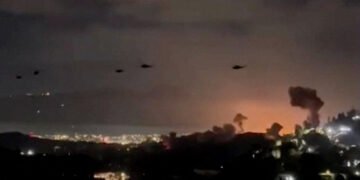























U.S. Military Strike Captures Venezuelan President Maduro
The United States executed a rapid military operation in Venezuela early Saturday, resulting in the seizure of President Nicolás Maduro and his wife, Cilia Flores. This action has heightened tensions in the region as the couple faces serious narcotics charges in U.S. courts.
Why It Matters
This unexpected move by the U.S. not only destabilizes Venezuela but also challenges the international balance of power in Latin America. With Maduro’s government under siege, the implications of this strike could reverberate through the region, potentially sparking unrest or a shift in governance.
Key Developments
- The U.S. conducted a military strike targeting Venezuelan military installations early Saturday morning.
- Explosions were reported in Caracas, lasting for approximately 30 minutes.
- Trump confirmed on social media that Maduro and his wife had been captured and removed from the country.
- The U.S. Attorney General announced charges including “Narco-Terrorism Conspiracy” against Maduro.
- Initial reports indicate casualties, but exact numbers remain unclear.
Full Report
Military Operation Details
Early Saturday, the skies over Caracas were filled with the sound of low-flying aircraft and the echoes of explosions. Witnesses reported at least seven blasts during a military operation that targeted key military infrastructure in the Venezuelan capital. Smoke billowed from a military base hangar, and power was knocked out at another military site.
According to U.S. officials, Maduro and Flores were taken from their residence at the Ft. Tiuna military complex. Trump confirmed their capture, asserting they were taken aboard a U.S. warship destined for New York to face prosecution.
Legal Implications
U.S. Attorney General Pam Bondi stated the couple has been indicted in the Southern District of New York, with Maduro facing multiple charges related to drug trafficking and arms possession. While the U.S. does not recognize the jurisdiction of the International Criminal Court, the legal ramifications of this military move remain ambiguous under domestic law.
Reactions and Ramifications
In response to the U.S. action, Maduro’s government condemned the military strike as an imperialist assault and called upon citizens to rise in protest. While militia members took to the streets in some neighborhoods, many areas of Caracas appeared eerily quiet following the attack. The country’s Vice President, Delcy Rodríguez, should legally assume power but no confirmations of this transition have surfaced thus far.
Trump indicated that the U.S. will continue to be actively involved in determining Venezuela’s future governance, raising questions about the stability of the region moving forward.
International Responses
Venezuela’s neighbors reacted swiftly; Colombia deployed troops to its border anticipating a possible influx of refugees. The region is deeply divided over the strikes, with leaders like Argentina’s President Javier Milei voicing support, while Brazil’s Luiz Inácio Lula da Silva condemned the actions. Cuba characterized the operation as a criminal attack, urging global intervention. In Europe, officials expressed concerns regarding the legality of the U.S. operation, emphasizing the importance of international law and a peaceful transition for Venezuela.
Context & Previous Events
The U.S. military action followed months of increasing pressure from the Trump administration, which had escalated naval forces in nearby waters and conducted drone strikes on alleged drug-trafficking operations linked to Venezuela. Maduro had previously faced an indictment from the U.S. in March 2020, and a recent surge in U.S.-led military activity marked a significant turning point in the relations between the two countries.






