






















U.S. Military Operation Captures Venezuelan President Nicolás Maduro
The U.S. military has reportedly captured Venezuelan President Nicolás Maduro following a large-scale military operation in the South American nation. The U.S. strikes, which resulted in significant explosions in Caracas, have prompted the Venezuelan government to demand proof of Maduro’s survival and declare a national emergency.
This development marks a dramatic escalation in U.S.-Venezuela relations, which have been fraught with tension and accusations for years. Maduro’s capture comes amid ongoing U.S. efforts to combat drug trafficking linked to Venezuelan leadership, giving this operation significant geopolitical implications.
Key Developments
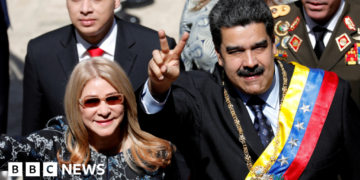
- U.S. President Donald Trump confirmed that Maduro and his wife, Cilia Flores, were captured and removed from Venezuela.
- Explosions were reported at key military sites in Caracas, including the military airfield La Carlota and Fuerte Tiuna, one of the largest bases.
- Venezuelan officials have demanded immediate proof of life for Maduro and condemned the U.S. strikes as a serious military aggression.
- Trump has promised more details about the operation during a scheduled press conference.
Full Report
The Operation
In the early hours of Saturday, loud explosions echoed throughout Caracas, leading to chaos and confusion. Reports indicate that multiple military installations were targeted, resulting in extensive damage and power outages in surrounding communities.
President Trump announced on his Truth Social platform that the operation resulted in the capture of Maduro and his wife, carried out in coordination with U.S. law enforcement. He stated, “The United States of America has successfully carried out a large scale strike against Venezuela and its leader, President Nicolás Maduro, who has been, along with his wife, captured and flown out of the Country.”
Further details on the specific nature of the military operation have not yet been disclosed, but there are indications that elite U.S. military units, such as Delta Force, were involved.
Venezuelan Government’s Response
In the wake of the operation, Vice-President Delcy Rodríguez expressed grave concerns over Maduro’s whereabouts, emphasizing the need for immediate proof that he and Flores are alive. Venezuela’s Defense Minister, Vladimir Padrino López, claimed that the strikes targeted civilian areas and warned of retaliation against foreign military presence.
The Venezuelan government issued an official statement condemning the U.S. actions as a violation of national sovereignty and an attack on peace and stability. They allege the strikes aim to seize the country’s strategic resources, particularly oil and minerals.
Trump’s Stance
Following the initial explosions, there was an initial silence from the White House. However, President Trump later reaffirmed the U.S. military’s involvement, framing the operation in the context of his administration’s ongoing campaign against drug trafficking linked to Maduro’s regime.
Context & Previous Events
Nicolás Maduro rose to power after the death of longtime leader Hugo Chávez in 2013 and has faced ongoing challenges regarding his legitimacy, particularly following the controversial 2024 presidential election. The U.S. has long accused Maduro of orchestrating drug smuggling operations and designated Venezuelan gangs, such as Tren de Aragua and Cartel de los Soles, as Foreign Terrorist Organizations, claiming that Maduro has leadership ties to these groups.
In recent months, U.S. naval forces have conducted operations against vessels suspected of drug trafficking in the Caribbean, further straining relations between the two nations. The U.S. previously offered a $50 million reward for information leading to Maduro’s capture.