






















Yemen Faces Potential Partition Amid Rising Tensions Between Gulf Powers
Yemen’s fragile situation deteriorated further last month as forces from the separatist Southern Transitional Council (STC) launched significant offensives in the eastern part of the country. This development has ignited unprecedented confrontations between Saudi Arabia and the United Arab Emirates, both of which have previously supported Yemen’s recognized government but are now backing rival factions, raising fears of a potential partition.
Why It Matters
The escalating conflict not only threatens Yemen’s stability but also signals a broader struggle for influence between Saudi Arabia and the UAE in the region. With Yemen already suffering from one of the worst humanitarian crises in the world, any further fragmentation could worsen the plight of millions and destabilize the surrounding areas.
Key Developments
-
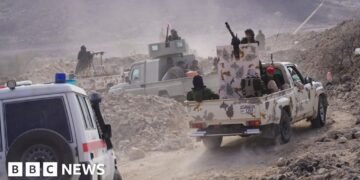
Military Offensives: On December 2, the STC initiated a large-scale military offensive in eastern Yemen, capturing territory from forces aligned with the government, including the oil-rich Hadramawt province, which borders Saudi Arabia.
-
Escalating Attacks: The STC declared a "war," accusing Saudi-backed forces of an offensive supported by airstrikes from the Saudi air force. A recent airstrike on an STC camp in Hadramawt resulted in seven fatalities.
-
Accusations and Denials: The Saudi-led coalition accused the UAE of supplying military equipment to the STC, complicating the situation further. In response, the UAE denied these allegations and stated that its forces would withdraw from Yemen following rising tensions.
- Ceasefire Breakdown: The fragile coalition among anti-Houthi groups, epitomized by the Presidential Leadership Council (PLC) formed in 2022, has fractured, raising fears of a larger conflict.
Full Report
Military Escalation
The STC’s offensive marks a turning point in Yemen’s ongoing civil war, which began in 2014 with the Iran-backed Houthi movement’s takeover of northern territories, including the capital, Sanaa. The STC is pushing for the establishment of an independent southern state, a demand that has gained traction as they solidify control over much of southern Yemen.
On Friday, confrontations escalated, resulting in multiple airstrikes by the Saudi coalition targeting STC positions, reportedly as a response to the group’s military actions. Tensions flared with fatalities reported from both sides.
Humiliation and Withdrawal
Following significant military and political pressure, the head of Yemen’s Presidential Council stated that the joint defense treaty with the UAE had been terminated, demanding a rapid withdrawal of Emirati forces. Saudi Arabia echoed this demand, asserting that threats to its national security were non-negotiable.
The UAE’s swift concession to withdraw its forces raised eyebrows; however, analysts suggest that this decision may not significantly alter the landscape, as the UAE has primarily relied on proxy forces for its military operations in Yemen since 2019.
Humanitarian Crisis
Yemen is currently navigating one of the world’s direst hunger crises, exacerbated by years of conflict. Over 19 million people are in need of humanitarian assistance, and previous estimates indicated that approximately 377,000 deaths could be attributed to the war, including a substantial number of children.
Families in newly contested areas, particularly in Hadramawt, are bracing for the possibility of intensified fighting, leading many to stockpile necessities amid growing uncertainty.
Context & Previous Events
The Yemeni civil war began in earnest in 2014 when the Houthis took control of significant territories, leading to a Saudi-led military intervention in 2015 aimed at restoring the recognized government. While a ceasefire had somewhat alleviated tensions with the Houthis in recent years, divisions among anti-Houthi factions—including the PLC and the STC—have become increasingly pronounced. The majority of southern Yemen is now firmly under STC control, further complicating the existing geopolitical dynamics in the region.