






















A Hilltop Discovery in Ireland Challenges Viking Settlement Theory
A recent excavation of a large hilltop settlement in Ireland may rewrite the narrative surrounding the origins of urban life in the region. Researchers have unearthed over 600 suspected houses at the Brusselstown Ring, suggesting that this site could precede Viking settlements, long thought to be the first towns in Ireland.
Why It Matters
The discovery of Brusselstown Ring raises substantial questions about the early development of settlements in Ireland, particularly the misconception that Viking influence marked the beginning of urban organization. With evidence suggesting significant habitation as far back as 1200 BC, this finding compels a reassessment of historical timelines and settlement structures in prehistoric Britain and Ireland.
Key Developments
- Excavation reveals over 600 house platforms, marking the largest known settlement site in prehistoric Ireland and Britain.
- Settlements date back to approximately 1200 BC, challenging the belief that Vikings were the first to establish towns in Ireland.
- Findings include a stone-lined chamber believed to be a water cistern, a unique discovery for Ireland.
- The site features two defensive ramparts, making it one of the few hillforts in Europe to span multiple hills.
Full Report
A Landmark Excavation
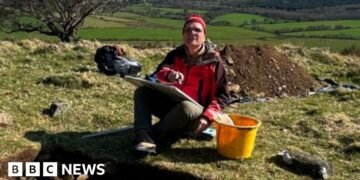
A team led by Dr. Dirk Brandherm, a reader in prehistoric archaeology at Queen’s University Belfast, conducted the excavation between August 23 and September 4, 2024. The team, which included PhD researcher Cherie Edwards and research fellow Dr. Linda Boutoille, focused on understanding the site’s historical significance. Their findings were published in the peer-reviewed journal Antiquity.
Evidence of Prehistoric Life
According to the study, Brusselstown Ring exhibits “exceptional size, density of occupation, and architectural complexity.” Unlike previous assumptions that prehistoric communities were primarily made up of small hamlets, this site suggests an organized structure that could be classified as a proto-town.
Dr. Brandherm noted the importance of the high number of roundhouses found, remarking, “If you’ve got more than 600 roundhouses… we’re talking about a proto-town of sorts, and that’s 2,000 years before the Vikings.” This dramatically shifts the timeline for urban development in Ireland.
Unique Structural Features
In addition to the houses, the excavation revealed a stone-lined, flat-floored chamber, described as “boat-shaped,” which may have served as a water cistern. This type of structure is unprecedented in Ireland, though similar ones have been found in France and Spain from the Bronze Age and Iron Age. Further research will confirm the age of this cistern and its connection to the roundhouses.
The excavation team also examined the house platforms to explore potential social stratification within the community. Different sizes of houses—from approximately four to twelve meters in diameter—suggest that the settlement may have had varying social or economic hierarchies, although current data does not definitively confirm this.
Context & Previous Events
Previously, the largest known cluster of ancient settlements was located in Mullaghfarna, County Sligo, which is estimated to have contained over 150 houses. This new finding at Brusselstown Ring significantly eclipses that evidence, positioning it as the largest nucleated settlement known in prehistoric Ireland and Britain to date.
Future research at the site will prioritize confirming the nature and dating of the potential cistern, identifying the structural features of the roundhouses, and clarifying the chronology of the settlement’s enclosing elements.






