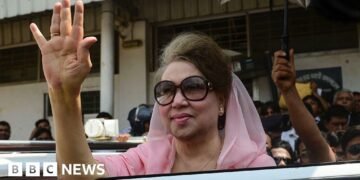























Bangladesh’s First Female Prime Minister Khaleda Zia Passes Away at 80
Khaleda Zia, who made history as Bangladesh’s first female prime minister, has died at the age of 80 after a prolonged illness. Zia passed away early this morning, as confirmed by her political party, the Bangladesh Nationalist Party (BNP), via social media.
This marks a significant moment in Bangladeshi politics, as Zia was a pioneering figure in the nation’s democratic landscape. Her leadership shaped the country’s political discourse and her death may impact the ongoing rivalry among major political factions.
Key Developments
- Zia’s health had been critically deteriorating, with physicians placing her on life support prior to her passing.
- She served as prime minister from 1991 and again from 2001 to 2006, with a substantial tenure that defined her political legacy.
- The BNP confirmed her death through a statement on Facebook, mourning the loss of their “favourite leader.”
- Her political career was fraught with corruption accusations and fierce opposition from rival political leaders.
Full Report
Illness and Death
Doctors announced on Monday night that Zia’s condition had worsened significantly, describing it as “extremely critical.” Though she was put on life support, medical professionals indicated that her age and overall health prevented comprehensive treatment options.
Political Journey
Entering the political arena with a focus on the advancement of her party, the BNP, Zia became the first female head of government in Bangladesh in 1991 after a victory in the nation’s first democratic elections in two decades. She reclaimed the prime minister position in 2001 but stepped down in October 2006, prior to an anticipated general election.
Controversies and Challenges
Throughout her political career, Zia faced numerous allegations of corruption. Her rivalry with Sheikh Hasina, the leader of the Awami League who was ousted from office last year, was a defining element of her tenure. In 2018, she was sentenced to prison for five years on corruption charges, which further complicated her legacy.
Context & Previous Events
Khaleda Zia’s ascent to power followed a long period of political turmoil in Bangladesh, characterized by a cycle of military rule and democratic restoration. Her initial victory in 1991 represented a critical shift towards democratic governance, while her later controversies illustrate the challenges facing Bangladeshi politics.