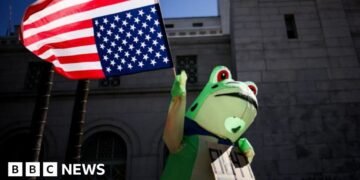























The Rise of the Frog: A Powerful Symbol in Modern Protests
In recent months, the image of a frog has morphed into a significant symbol for protests against the Trump administration. Initially ignited by a viral incident in Portland, Oregon, where a demonstrator donned a frog costume in defiance of law enforcement, this whimsical symbol has found traction across the United States, reflecting the evolving landscape of political resistance.
Why It Matters
The portrayal of political dissent has increasingly adopted elements of humor and absurdity, suggesting that even in serious times, protesters can employ creative strategies to challenge authority. This trend not only highlights the diverse ways in which citizens voice their grievances but also underscores the symbolic power of imagery in shaping public discourse and political narratives.
Key Developments
-
Viral Frog Incident: On October 2, an immigration officer in Portland sprayed crowd control chemicals at a protester dressed in an inflatable frog costume, which quickly circulated online, energizing protests across the nation.
-
Defining Symbol: The frog costume emerged as a potent emblem for left-leaning activists, contrasting with the earlier associations with far-right groups symbolized by characters like Pepe the Frog.
- Operation Inflation: A grassroots initiative called "Operation Inflation" has started to supply inflatable costumes to protesters, aimed at altering public perception around protests and countering narratives of violence.
Full Report
Viral Moment in Portland
The confrontation in Portland came amidst heightened tensions as the Trump administration deployed the National Guard to the city. Protesters gathered outside an immigration facility, where the incident occurred. Protester Seth Todd, clad in a whimsical frog outfit, humorously responded to the use of chemicals aimed at him, further endearing the image of the frog to the public’s imagination.
The Symbolism of the Frog
Originally seen as a lighthearted character, the frog costume has transitioned from associations with right-wing sentiment epitomized by Pepe to a tool for peaceful protest. The tactic known as "tactical frivolity" serves to disarm the opposition and foster a non-violent atmosphere during protests. Professor LM Bogad, a scholar on performance art and political protest, emphasized that these costumes provide a layer of protection for critics of authority, allowing them to ridicule oppressive regimes without direct confrontation.
Nationwide Adoption
Following the incidents in Portland, the inflatable frog costume appeared in protests across various U.S. cities, from San Diego to Boston, gaining significant media traction. The cultural phenomenon even reached international shores, with costumes spotted at protests in cities as far away as Tokyo and Berlin.
Grassroots Movement: Operation Inflation
In response to the viral fame of the frog, residents of Portland launched "Operation Inflation," a movement dedicated to distributing inflatable costumes to protesters. This initiative is designed to reshape narratives surrounding protest movements, contrasting with the administration’s depiction of protesters as violent groups. Co-founder Brooks Brown remarked on the historical significance of their costumes, likening them to the dignified perseverance displayed during the Civil Rights Movement.
Context & Previous Events
The frog’s rise as a protest symbol parallels the controversial history of Pepe the Frog, created in 2005 but later adopted by far-right groups during the 2016 election cycle. Artist Matt Furie has sought to reclaim Pepe’s image, highlighting the struggle of creators to control their work amidst its cultural appropriation. The backlash against the symbolic appropriation of Pepe paved the way for the reimagining of the frog character within a new context, as artists and activists seize control of its narrative to advocate for progressive causes.
As this trend continues to evolve, the playful frog costume stands at the intersection of culture, politics, and protest, providing a unique lens through which to examine the power of imagery in contemporary American activism.