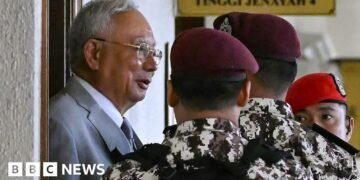























Former Malaysian Prime Minister Najib Razak has been sentenced to 15 years in prison after being found guilty of abuse of power and money laundering linked to a multi-billion-dollar scandal involving the state’s sovereign wealth fund, 1Malaysia Development Berhad (1MDB). This ruling marks a significant chapter in Malaysia’s ongoing struggle with high-level corruption and highlights the challenges faced within the country’s political framework.
Why It Matters
This verdict underlines the severe consequences of corruption at the highest levels of government, signaling to both politicians and the public that accountability is paramount. It also emphasizes ongoing challenges in Malaysia, where public institutions must be strengthened to ensure that political leaders serve the people’s interests rather than their own.
Key Developments
- Najib Razak, 72, received four concurrent 15-year sentences on abuse of power charges and additional sentences for money laundering.
- A judge found him guilty of misappropriating approximately 2.3 billion Malaysian ringgit ($569 million) from 1MDB.
- He is already serving time related to another 1MDB case, having been convicted in 2020.
- His bid to serve the remainder of his sentence under house arrest was rejected by the court earlier this week.
- Supporters gathered outside the court, insisting that Najib is a victim of political persecution.
Full Report
The court’s verdict, delivered in Putrajaya, concluded a lengthy legal battle lasting seven years, during which 76 witnesses provided testimony. Najib was found guilty on four counts of abuse of power and 21 counts of money laundering. The former prime minister has been imprisoned since 2022, and his recent sentences are designed to run concurrently. His previous conviction in a different 1MDB case involved 42 million ringgit ($10 million) wrongfully transferred into his private accounts, which led to a 12-year prison sentence that was subsequently reduced.
The key focus of the latest rulings involves transactions linked to Najib’s personal bank account in 2013, which he claimed were donations from the deceased Saudi King Abdullah. This defense was dismissed by the presiding judge, reinforcing the court’s stance on the legitimacy of the accusations against him. Najib maintains a loyal following, who believe he has been unjustly targeted politically. This narrative was echoed by supporters outside the courtroom on the day of the verdict.
Malaysia’s Prime Minister Anwar Ibrahim has called for unity among party leaders to respect judicial outcomes. The political ramifications of the verdict reverberated through Najib’s United Malays National Organisation (UMNO), with contrasting responses from allies and opponents alike. Notably, former lawmaker Tony Pua remarked that the ruling would serve as a warning to future leaders, indicating that corruption could lead to serious repercussions regardless of one’s political stature.
Amidst advancements in legal action against corruption, experts like Cynthia Gabriel argue that the systemic reforms are still inadequate. She highlighted the possibility that significant corruption incidents could occur again, underscoring the need for robust safeguards within Malaysia’s political institutions.
Context & Previous Events
The 1MDB scandal first emerged a decade ago, drawing in notable figures globally, including individuals from Goldman Sachs and Hollywood. An estimated $4.5 billion was purportedly siphoned from the sovereign wealth fund. Najib’s conviction for corruption in 2020 marked the beginning of a broader reckoning, culminating in the electoral defeat of his Barisan Nasional coalition in 2018, which had ruled Malaysia since independence in 1957. Najib’s wife, Rosmah Mansor, was convicted of bribery in 2022 and is currently out on bail pending appeal.