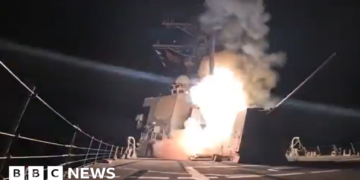























U.S. Launches Coordinated Strike Against Islamic State in Nigeria
The United States recently executed a significant military operation against the Islamic State (IS) group in northwestern Nigeria. This operation, described by President Donald Trump as a "powerful and deadly strike," underscores ongoing concerns regarding terrorism and violence in the region.
Why It Matters
The military action is part of a broader U.S. strategy to combat Islamist militant groups that pose threats not only to regional stability but also to global security. With the U.S. increasingly involved in international counterterrorism efforts, this operation highlights the complexities of navigating religious tensions and accusations of bias in conflict areas.
Key Developments
- President Trump characterized IS as "terrorist scum," citing the group’s violent actions against primarily innocent Christians in Nigeria.
- The strike was conducted in partnership with the Nigerian government, specifically targeting terrorist entities.
- Nigerian Foreign Minister Yusuf Maitama Tuggar emphasized that the operation was not religiously motivated and that further operations would depend on future decisions between Nigerian and U.S. leadership.
- The U.S. military has been preparing for action in Nigeria since November, with prior discussions around escalating efforts to combat Islamist groups.
- U.S. Defense Secretary Pete Hegseth acknowledged the critical cooperation from Nigeria in these efforts.
- Groups monitoring violence have noted that there is no substantial evidence to support claims that Christians are disproportionately targeted in Nigeria, where religious affiliations among victims of violence are mixed.
Full Report
Military Operation Details
On Thursday, the U.S. military successfully coordinated an attack on IS positions within Nigeria’s Sokoto state. President Trump disclosed the operation via social media, asserting that during his administration, the U.S. would not tolerate the advancement of radical Islamic terrorism. Following the airstrikes, the U.S. Africa Command (Africom) confirmed the engagement, enhancing collaborative efforts against ongoing threats in the region.
Nigerian Government Response
Nigerian authorities have expressed appreciation for U.S. collaboration in efforts to combat terrorism. The foreign ministry stated that they are committed to structured security cooperation with international partners, emphasizing their dedication to addressing terrorism and violent extremism. As attacks continue across the region, Nigerian officials have hinted that more military actions could be anticipated, depending on bilateral strategic discussions.
Claims of Religious Targeting
In recent months, discussions surrounding the persecution of Christian populations in Nigeria have surfaced, with Trump asserting that "thousands" had been killed in attacks. However, this claim has faced scrutiny, as monitoring organizations highlight a lack of evidence indicating that Christians are being targeted more than Muslims. Adviser Daniel Bwala noted that while Nigeria welcomes assistance in tackling jihadist insurgents, the violence affects individuals of all faiths indiscriminately.
Context & Previous Events
In November, President Trump initiated preparations for U.S. military engagement in Nigeria, pinpointing Islamist groups as a significant threat. Following his announcement declaring Nigeria a "Country of Particular Concern," due to concerns over religious freedom, Nigerian President Bola Tinubu committed to protecting communities of all faiths. Over the years, jihadist groups like Boko Haram and Islamic State West Africa Province have caused severe destruction, predominantly affecting Muslim populations, while central Nigeria experiences ongoing clashes over resources between differing religious groups. Human rights organizations continue to assert that no comprehensive evidence suggests that religious discrimination informs the violence in Nigeria.






