






















Trump Pushes for U.S. Claim on Greenland Amid National Security Concerns
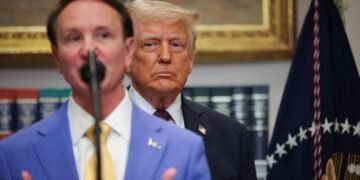
President Donald Trump is advancing his push for U.S. control over Greenland, citing national security as the primary motivation. Following the appointment of Louisiana Governor Jeff Landry as a special envoy to the semi-autonomous territory, Trump emphasized its strategic importance against a backdrop of escalating tensions with Russia and China.
Why It Matters
Greenland’s position between North America and Europe, as well as its rich mineral resources, have made it increasingly significant in geopolitical discussions. Trump’s insistence on acquiring the territory reflects broader security concerns, as reports indicate rising military activities in the Arctic region by both Russia and China. The potential annexation raises serious questions about international respect for territorial integrity and the implications for U.S. foreign relations.
Key Developments
- Trump has stated, "We need Greenland for national security," pointing to the presence of Russian and Chinese naval vessels in surrounding waters.
- Jeff Landry has been appointed as special envoy to advocate for U.S. interests in Greenland.
- Danish Prime Minister Mette Frederiksen and Greenland’s Prime Minister Jens-Frederik Nielsen issued a joint statement asserting that Greenland belongs to its people, rejecting any notion of annexation.
- Denmark’s Foreign Minister Lars Løkke Rasmussen reiterated the importance of respecting the nation’s territorial integrity in response to U.S. claims.
- Previous reports indicated covert influence operations linked to Trump’s associates in Greenland, prompting diplomatic protests from Danish officials.
Full Report
Strategic Interests
Trump’s remarks arose from concerns over national security, fueled by escalating military activities in the Arctic. He claimed that the U.S. needs Greenland primarily for its strategic location, which plays a critical role in supporting U.S. ballistic missile defense systems against potential threats.
In a meeting discussing these issues, Trump highlighted the strategic interest in monitoring foreign military activity in the region. "If you take a look at Greenland, you look up and down the coast, you have Russian and Chinese ships all over the place," he said, framing the narrative around U.S. defense readiness.
Responses from Denmark and Greenland
The reaction from Denmark has been swift and defensive. Both Prime Ministers emphasized that Greenland’s future is not up for negotiation, describing annexation as a violation of international law. This assertion was underscored by Denmark’s recent diplomatic actions, including summoning the U.S. ambassador to express their concerns regarding Trump’s ambitions.
Additionally, as tensions have escalated, Denmark’s Foreign Minister stressed mutual respect between allies, declaring that military threats are not an acceptable means for addressing international disputes.
Diplomatic Tensions
The situation follows a series of diplomatic developments earlier in the year. Vice President JD Vance’s visit to a U.S. military base in Greenland included criticisms of Denmark for underinvesting in the territory. These interactions seem to have reignited U.S. ambitions regarding Greenland, which many view as an integral part of Arctic strategy.
Context & Previous Events
The renewed interest in Greenland can be traced back to ongoing geopolitical shifts as noted in a report by the Danish Defence Intelligence Service. The report highlighted increasing military competition in the Arctic, exacerbated by rising tensions between Russia and NATO members, including the U.S.
Earlier this year, U.S. officials were involved in discussions pertaining to defense and investments in Greenland, which had previously faded from public discourse but have now been revived as a focal point of U.S. security strategy. The evolving dynamics in the Arctic continue to shape U.S. foreign policy and diplomatic relations with allies and rivals alike.






