






















Violence Erupts in Bangladesh Following Death of Youth Protest Leader
A significant surge of violence ignited in Bangladesh after the death of a prominent youth activist, leading to protests and the destruction of media offices. This tragic incident not only deepens the political crisis in the country but also poses grave concerns for independent journalism amid a volatile pre-election atmosphere.
Why It Matters
The recent unrest marks a pivotal moment in Bangladesh’s struggle for democracy and journalistic freedom, particularly in the wake of increasing suppression of dissent and media criticism. As the country approaches elections planned for February, the tension between the interim government and its critics highlights the fragile state of civil liberties that may be threatened further by ongoing political turmoil.
Key Developments
- Protests erupted following the death of Sharif Osman Hadi, a prominent youth leader of the Inqilab Mancha student organization, who was shot in Dhaka.
- Demonstrators targeted the offices of major newspapers, The Daily Star and Prothom Alo, leading to extensive property damage.
- This marks the first time in 35 years that The Daily Star was unable to publish its print edition.
- The interim government condemned the violence, pledging justice for the attacks on journalists.
- Hadi’s demise is seen as a potential tactic to stifle opposition ahead of the upcoming elections.
Full Report
Violence at Media Outlets
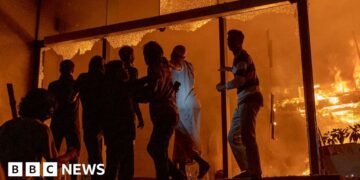
On Thursday night, hundreds of protesters stormed the offices of The Daily Star and Prothom Alo, expressing their outrage over Hadi’s death. Staff members described being trapped on the building’s rooftop, struggling to breathe as they awaited rescue. Fortunately, no serious injuries were reported, but large sections of both buildings were left severely damaged.
The Daily Star issued a statement calling it “one of the darkest days for independent journalism in Bangladesh,” highlighting the gravity of the attacks on press freedom. Consultative editor Kamal Ahmed stated that the paper would remain inoperable for an unspecified period and emphasized the level of danger faced by journalists during the unrest.
The Context of Hadi’s Death
Sharif Osman Hadi, aged 32, was a prominent figure in the youth-led protests that led to the ouster of former Prime Minister Sheikh Hasina. He had plans to run as an independent candidate in the upcoming elections but was gunned down shortly after the election date was announced. His death has been labeled by the interim government as a premeditated act intended to derail the country’s democratic progress.
In a televised address, interim leader Muhammad Yunus characterized Hadi’s killing as an “irreparable loss for the nation,” asserting that fear tactics would not impede the journey toward democracy.
Government’s Response
The interim administration condemned the violence against journalists, stating that “attacks on journalists are attacks on truth itself.” Yunus’s government declared a national day of mourning and has initiated investigations into Hadi’s assassination, resulting in several arrests.
Context & Previous Events
Hadi’s death and the subsequent unrest occur against a backdrop of significant political tension in Bangladesh, particularly in the lead-up to elections next February—the first since Hasina’s ouster. Hasina, who fled to India in 2004 following student-led protests, has faced intense scrutiny for her administration’s authoritarian tendencies.
In November, she was sentenced to death for crimes against humanity, further complicating the political climate in a nation seeking stability and democratic governance.