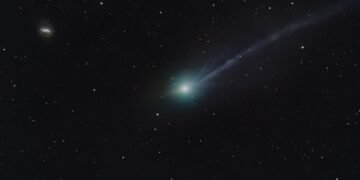























Controversy Surrounds Mysterious Object Approaching Earth
A peculiar object, 3i/ATLAS, is set to make its closest approach to Earth this Friday, sparking intense debate among scientists. While most astronomers categorize it as a comet from beyond our solar system, one Harvard astrophysicist warns it could be evidence of extraterrestrial life, elevating concerns over the implications of encountering potential alien technology.
Why It Matters
This has wide-ranging implications for our understanding of the cosmos and humanity’s place within it. As technology advances and more celestial bodies are explored, the prospect of alien life raises essential questions about safety and our readiness to react to unknown entities.
Key Developments
- The object will pass by Earth at a speed of 130,000 mph, approximately 170 million miles away.
- Most astronomers classify it as a comet, while Professor Avi Loeb suggests it could be an alien craft.
- NASA and European space agencies maintain there is no evidence to support the claim of extraterrestrial origins.
- 3i/ATLAS has been under observation by a network of spacecraft, confirming its natural origin.
- The object is estimated to be around eight billion years old, providing valuable insights into cosmic history.
Full Report
3i/ATLAS, first detected in July, is currently hurtling through our solar system and will soon fly past Jupiter before disappearing from view. Professor Avi Loeb, a notable figure from Harvard University, raised the alarm by announcing that humanity should be vigilant about this “black swan event,” referring to unlikely yet consequential occurrences. He remarked, “When there are implications to society, we must consider even an unlikely event and collect as much data as possible.”
Loeb’s assertions center on the object’s unusual characteristics, such as a tail that may suggest a propulsion system and the presence of nickel in its gas cloud, which could imply metal mining activity. He opposes the prevailing scientific consensus that identifies it purely as a comet, a stance that has ignited criticism within the astronomical community.
NASA’s Amit Kshatriya expressed confidence in the classification of the object, stating, “This object is a comet. It looks and behaves like a comet. All evidence points to it being a comet.” Other astronomers, including Professor Chris Lintott from the University of Oxford, emphasized that there is nothing extraordinary about 3i/ATLAS. “It’s just nonsense,” he said, suggesting that claims of alien involvement are unfounded and compared them to the myth that the moon is made of cheese.
Loeb contended that many experts dismiss alternative explanations too readily, asserting that genuine scientific inquiry requires openness to new possibilities. Yet, Lintott cautioned against the dangers of speculative theories devoid of supporting evidence, emphasizing that while looking for extraterrestrial intelligence is worthwhile, it should be approached with rigor and caution.
Context & Previous Events
This isn’t the first time Professor Loeb has suggested that unusual celestial phenomena could indicate alien life. He made similar claims regarding Oumuamua, another interstellar object that traversed our solar system in 2017.