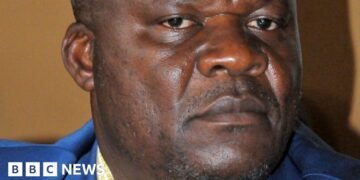























A French court has sentenced former rebel leader and Congolese politician Roger Lumbala to 30 years in prison after finding him guilty of complicity in crimes against humanity dating back over 20 years. The ruling highlights ongoing efforts to secure justice for atrocities committed during the Second Congo War, which resulted in millions of casualties.
This verdict is significant as it represents a notable step in the quest for accountability in long-standing conflicts that have plagued the Democratic Republic of Congo (DRC). Lumbala’s conviction serves as a reminder that international justice mechanisms can hold individuals responsible for heinous acts, even when committed outside of their own countries.
Key Developments
- Roger Lumbala was found guilty of aiding and abetting various serious crimes, including torture, sexual slavery, and summary executions.
- The 67-year-old did not accept the court’s legitimacy and did not attend much of the trial.
- His arrest in France came nearly five years ago following an arrest warrant issued by the Congolese government.
- Survivors and advocates welcomed the ruling as a milestone in the fight for justice in the DRC.
Full Report
The Court’s Findings
The court determined that Lumbala was involved in operations conducted by a rebel movement he led, which was supported by Uganda. During the Second Congo War, this group was responsible for numerous atrocities during a campaign known as “Erase the Slate.” The court heard compelling testimonies that detailed the cruelty inflicted on targeted ethnic groups, including torture, theft, and sexual violence.
Survivor Testimonies
Victims of the violence bravely shared their experiences during the trial. Two survivors expressed their relief at the verdict, stating that while they had hoped to confront Lumbala in court, the outcome marked a significant step in reclaiming their dignity.
One survivor, David Karamay Kasereka, described tragic events involving his own family during the conflict, while another, nurse Pisco Sirikivuya Paluku, recounted instances of robbery and murder by Lumbala’s forces. Their moving statements underscore the enduring impact of the war’s violence on individuals and communities.
The Legal Framework
Lumbala’s prosecution was grounded in the principle of “universal jurisdiction,” enabling French courts to address human rights violations committed internationally. The involvement of several NGOs, including Trial International and the Clooney Foundation for Justice, facilitated the gathering of testimonies and expert analyses that bolstered the case against him.
Reactions and Next Steps
While the prosecution sought a life sentence, Lumbala’s legal team plans to appeal the ruling, labeling the sentence as excessive. The ongoing instability in eastern DRC, marked by more than three decades of conflict, adds urgency to the need for accountability. Observers from human rights organizations view this verdict as a landmark moment in confronting the impunity that has long enabled such atrocities.
Context & Previous Events
Roger Lumbala previously served as a minister in DR Congo’s transitional government and was involved in politics following the war. He fled to France after the Congolese government issued an arrest warrant for his alleged support of the M23 rebel group.
The Second Congo War, which lasted from 1998 to 2003, involved multiple nations and rebel factions and resulted in an estimated two to five million deaths. This trial follows a series of prosecutions at the International Criminal Court for other militia leaders implicated in similar crimes.