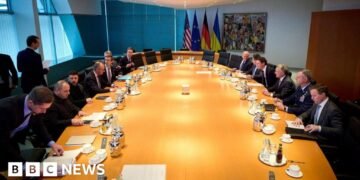























Negotiations Continue in Berlin for Ukraine-Russia Peace Deal
Discussions aimed at establishing a peace agreement between Ukraine and Russia are entering their second day in Berlin, featuring high-level talks involving Ukrainian President Volodymyr Zelensky and U.S. officials. The outcome of these discussions holds significant implications for regional stability as Ukraine seeks robust security assurances amidst its ongoing conflict with Russia.
Why It Matters
The negotiations represent a crucial moment for Ukraine, grappling with the challenges of war and significant infrastructural damage. As the country endures its fourth winter of conflict, securing reliable security guarantees is paramount to prevent future aggression from Russia. The outcome will not only affect Ukraine’s sovereignty but also impact U.S. foreign policy and European stability.
Key Developments
- Ukrainian President Volodymyr Zelensky, along with negotiator Rustem Umerov, met U.S. envoy Steve Witkoff and Jared Kushner for five hours on Sunday.
- Zelensky expressed willingness to forego NATO membership in exchange for strong security guarantees.
- The talks involve a 20-point peace plan proposal from Ukraine aimed at addressing previous plans perceived as biased towards Russia.
- Key European leaders, including German Chancellor Friedrich Merz and European Commission President Ursula von der Leyen, are expected to join the negotiations.
- The Kremlin reiterated its stance that Ukraine’s NATO aspirations are a non-negotiable issue.
Full Report
Negotiations Underway
In Berlin, the discussions have resumed with Zelensky signaling a significant shift in Ukraine’s position regarding NATO, emphasizing the need for security guarantees akin to Article 5 of the NATO treaty. “This is already a compromise on our part,” Zelensky remarked as he acknowledged opposition from some Western partners towards Ukraine’s NATO ambitions.
Ukraine’s Proposal
The central topic of the negotiations revolves around a 20-point peace plan that Ukraine presented to the U.S. last week. While the details of this plan remain under wraps, Zelensky described it as a foundation for reconstruction and security assurances for Ukraine, amid concerns over potential Russian aggression.
Key Participants
The meetings are also marked by the participation of NATO’s Supreme Allied Commander Europe, General Alexus Grynkewich. Witkoff, having engaged with Russian President Vladimir Putin previously, highlighted the complexity of this negotiation, which includes potential Russian interests relayed through U.S. representatives.
Sovereignty Issues
Zelensky addressed the contentious issue of control over the Donbas region, currently under significant Russian occupation. While he expressed openness to a ceasefire along existing front lines, he firmly stated that Ukraine would not withdraw its forces without reciprocal actions from Russia. Describing the matter as “extremely sensitive,” Zelensky emphasized that a fair agreement requires equal consideration from both sides.
EU Involvement
The timing of these negotiations is critical, particularly as EU countries prepare to vote on a contentious plan to utilize frozen Russian assets to bolster Ukraine’s economy. While a consensus on this issue remains elusive, EU foreign policy chief Kaja Kallas noted the complexity of ongoing discussions and stressed the importance of progress in the coming days.
Context & Previous Events
This round of talks follows a previous U.S. proposal that Ukraine deemed unfavorable. The Kremlin has consistently maintained its opposition to Ukraine’s NATO membership aspirations, describing the issue as a cornerstone of negotiations. As the war continues, Ukraine faces dire humanitarian challenges, including power cuts affecting millions due to ongoing strikes on its energy infrastructure.