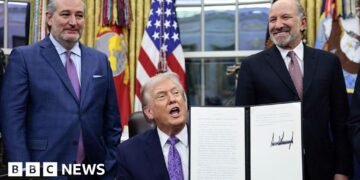























In a significant move, President Donald Trump has signed an executive order intended to prevent states from imposing their own regulations on artificial intelligence (AI). The directive aims to centralize oversight and aligns with the push from major tech companies for uniform AI legislation across the United States.
This decision underscores the administration’s commitment to fostering innovation in the rapidly expanding AI sector, amidst concerns that state-level rules could hamper technological advancement and the U.S.’s competitive edge over China.
Key Developments
- Trump’s executive order seeks to block states from enforcing independent AI regulations.
- The White House claims the order will help combat the “onerous” rules set by individual states.
- AI regulations concerning children’s safety will remain supported by federal efforts.
- California’s Governor Gavin Newsom criticized the move, accusing Trump of corruption.
- Other states, including Colorado and New York, have already enacted their own AI regulations.
Full Report
A Centralized Approach
During a press briefing in the Oval Office, Trump stated, “We want to have one central source of approval,” emphasizing the need for uniformity in AI regulation. David Sacks, an AI adviser at the White House, remarked that the executive order equips the administration to challenge stringent state regulations, which they argue could impede progress within the industry.
Support from the Tech Industry
The decision has been positively received by leaders in the technology sector, who have expressed concerns that fragmented state-level regulations could stifle innovation. As investment in AI technology continues to soar—amounting to billions of dollars—industry executives believe that a cohesive federal framework is essential for maintaining the U.S.’s global leadership in AI.
Pushback from Critics
Opponents of the executive order argue that it undermines states’ rights to enact necessary protections for their residents. Governor Newsom described Trump’s action as an attempt to exploit the situation for personal gain, stating, “Today, President Trump continued his ongoing grift in the White House.” He noted his state’s existing laws that require major AI companies to devise plans to mitigate potential risks from their technologies.
Advocacy groups such as Mothers Against Media Addiction echoed similar sentiments, asserting that allowing states to set their own safeguards is crucial in absence of federal oversight. Julie Scelfo from the group stated that stripping states of this authority risks the well-being of their citizens.
Context & Previous Events
California, which houses some of the globe’s leading tech firms, has been proactive in establishing regulations targeting AI technologies. Earlier this year, Governor Newsom signed a bill requiring top AI developers to outline measures to handle risks associated with their AI models. Additionally, states like Colorado and New York have also initiated their own legislative efforts to regulate AI development.